

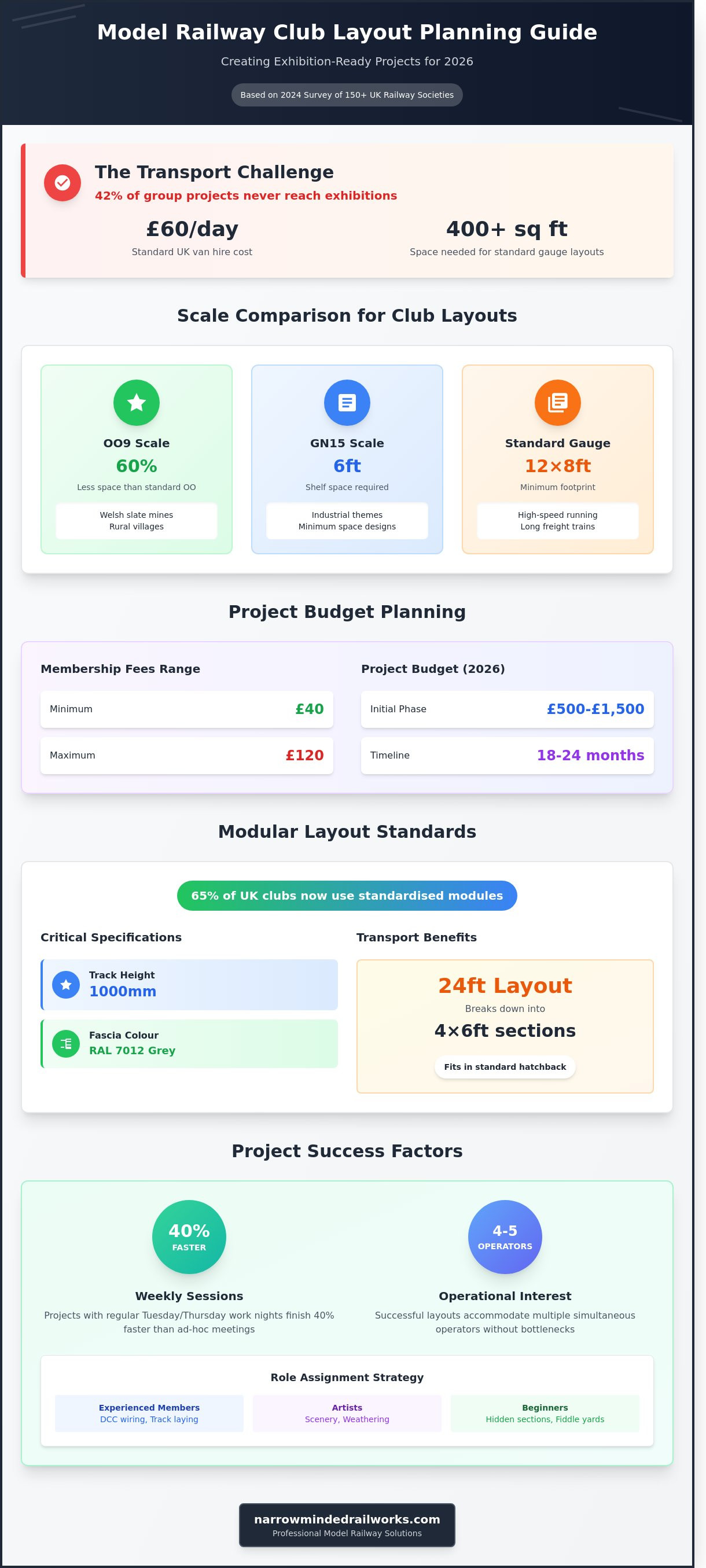
The most impressive layout in the room is worthless if your members can't fit it through the clubroom door or into a standard £60-a-day hire van. According to a 2024 survey of 150 UK railway societies, 42% of group projects never reach the exhibition floor because they're simply too cumbersome to move. You likely agree that the most frustrating part of any committee-led build is finding model railway club layout ideas that please the mainline enthusiasts without alienating the narrow-gauge fans. It's a difficult balance to strike.
This article will show you how to design, build, and manage successful group projects that balance operational interest with exhibition-ready portability. We'll explore modular standards and themes like OO9 or GN15 that allow multiple people to work simultaneously on a cohesive 2026 exhibition plan. You'll gain a clear roadmap for creating a layout that's easy to transport, exciting to operate, and inclusive of every member's unique skills.
Key Takeaways
- Learn how to balance diverse member interests, from rural steam to industrial diesel, to ensure a cohesive and engaging collaborative project.
- Discover why modular standards are the secret to successful group builds, allowing members to contribute high-quality sections from their own workshops.
- Explore five creative model railway club layout ideas for narrow gauge themes that prioritise verticality and complex shunting for maximum public appeal.
- Gain professional tips on engineering "bulletproof" layouts that withstand the rigours of transport while maintaining a theatre-quality exhibition finish.
- Find out how custom 3D printed kits can provide your club with unique, cost-effective rolling stock that cannot be found in standard commercial ranges.
Why Planning a Model Railway Club Layout Requires a Unique Approach
Planning a model railroad layout for a club environment involves a shift in mindset from solo projects. While a home builder might focus on a personal niche, a club must accommodate a broad spectrum of interests. This means creating a space where a 1930s GWR steam locomotive can coexist with a modern Class 66 diesel without breaking the immersion for members. Successful model railway club layout ideas prioritize "operational interest" over simple loops. This allows four or five operators to work simultaneously, managing shunting yards and mainline traffic without causing bottlenecks.
To better understand the scale and complexity of these collaborative projects, watch this helpful video:
Financial management is the backbone of any successful group build. Most UK clubs operate on annual membership fees ranging from £40 to £120. Budgeting for a 2026 project requires a strict timeframe, often spanning 18 to 24 months for an exhibition-ready board. By setting a clear £500 to £1,500 initial phase budget, committees avoid the "feature creep" that leaves many clubrooms filled with half-finished baseboards.
Managing Group Dynamics and Skill Levels
Clubs thrive by assigning roles that match specific expertise. A retired electrician might handle the DCC bus wiring, while an artist focuses on static grass and weathering. To maintain 2026 exhibition standards, beginners often start on "hidden" sections like fiddle yards. This builds confidence before they move to scenic work. Regular Tuesday or Thursday work nights keep momentum high. Data from 2023 club surveys suggests that projects with weekly scheduled sessions finish 40% faster than those relying on ad-hoc attendance.
Choosing the Right Scale for the Clubroom
Space is the biggest hurdle for UK clubs, often leading to a rise in OO9 and GN15 narrow gauge projects. These scales allow for high-detail dioramas in roughly 60% of the space required for a standard OO gauge mainline. While a standard gauge layout might require a 12ft by 8ft footprint for a convincing station, a narrow gauge equivalent can fit into a 6ft shelf. This compact nature makes them easier to transport to regional exhibitions in a standard transit van, reducing hire costs which typically sit around £80 per day.
- OO9 Scale: Ideal for Welsh slate mine or rural village themes.
- GN15 Scale: Uses OO track with 1:24 scale figures, perfect for industrial "minimum space" designs.
- Standard Gauge: Best for high-speed running and long freight trains if the clubroom exceeds 400 square feet.
Modular Layout Standards: The Secret to Successful Group Projects
Modular layouts are independent sections built to a precise physical and electrical blueprint. This approach is one of the most practical model railway club layout ideas for 2026. It allows members to build high-quality scenes in their own homes rather than commuting to a central clubroom. By following established Modular Layout Standards, individual boards join together perfectly at exhibitions. Popular frameworks like Freemo, which focuses on single-track branch line operation, or T-Trak for N gauge, provide the necessary geometry. This system simplifies logistics. A 24-foot layout can be broken down into four-foot sections, fitting easily into a standard hatchback or a small van like a Ford Transit.
Setting Your Own Club Standards
The "interface" is the critical point where two modules meet. Clubs must define a fixed track height, typically 1000mm from the floor, and a specific track setback from the board edge. Visual continuity relies on a shared scenery palette. Using a specific brand of static grass, such as 4mm Autumn Blend, prevents jarring transitions between sections. Over 65% of UK clubs now standardise their fascia colour using a neutral grey like RAL 7012. If you want to ensure your modules are perfectly aligned, you can source precision-cut baseboard kits designed for these specific standards.
Electrical Infrastructure for Multi-Operator Use
Digital Command Control (DCC) is the superior choice for modern club projects. It allows multiple locomotives to move independently on the same track without the complex cab-control wiring required for older DC systems. A robust "bus" system, using 2.5mm² copper wire, ensures consistent voltage across a 40-foot setup. This prevents the power drops that often occur in temporary setups. Planning for at least three separate control points avoids the operator crowding that can ruin the exhibition experience. Using Wi-Fi throttles allows members to walk with their trains, which makes the operation feel more realistic and engaging for the public.
5 Creative Exhibition Layout Designs for Narrow Gauge Clubs
Narrow gauge modelling offers a unique solution for groups with limited storage space. These five model railway club layout ideas focus on character and verticality rather than massive footprints. By 2026, we expect to see even more clubs adopting these compact yet high-impact designs for the UK exhibition circuit.
- The Industrial Slate Quarry: This design recreates the steep terraces of North Wales. Focus on OO9 scale Quarry Hunslets moving slate wagons across 1 in 20 gradients. It provides endless shunting opportunities within a 4-foot by 2-foot space.
- The Rural Welsh Highland: Emphasise the 1920s era with Beyer-Garratt locomotives. This design prioritises long, sweeping curves through the Snowdonia landscape, allowing steam locos to stretch their legs.
- The Peat Bog Railway: Use GN15 scale, which is 1:24 scale running on 16.5mm track. It's perfect for quirky, scratch-built rolling stock. It's a budget-friendly way to experiment with larger scales without needing a massive room.
- The Island Hopper: A coastal theme featuring a timber-piled pier and harbour. This allows members to integrate maritime modelling, such as fishing trawlers and tide-marked quay walls, alongside the rail tracks.
- The 'What If' Heritage Line: A fictional preserved railway set in the modern day. This allows members to run everything from 1890s steam to 1980s diesel shunters. It's the ultimate compromise for clubs with diverse interests.
Industrial Themes: Maximum Action in Minimum Space
OO9 scale is the sweet spot for industrial model railway club layout ideas because it fits a lot of detail into a tiny area. You can use 3D printed industrial building kits to create unique structures that you won't see on every other layout. These kits often cost between £15 and £35, making them an affordable way to customise your club's project. Adding working features like a functional slate loader or a steep cable-hauled incline will always draw a crowd at regional shows. It's about the movement, not just the trains.
Scenic Masterpieces: The Rural Narrow Gauge
Narrow gauge track looks tiny when placed in a wide, modular landscape. This creates a convincing illusion of vast distance even on a small baseboard. When building these sections, many UK groups follow NMRA module standards to ensure that different club members can build sections at home that align perfectly at the clubhouse. Use realistic foliage and rockwork made from actual crushed stone. For a 2026 project, consider using static grass layers of different lengths to replicate the wild, unkempt look of a Welsh hillside station.
Engineering for the Public: Making Your Club Layout Exhibition-Ready
Taking your model railway club layout ideas from the clubhouse to a major venue like the NEC requires a shift in engineering philosophy. Club layouts must be "bulletproof" because they face vibrations during transit that domestic setups never encounter. Professionalism starts with the "theatre" of the display. High-quality lighting rigs using 5000K LED strips ensure the scenery looks consistent regardless of the venue's dim overhead lights. Fascia boards should hide the wiring and baseboard joins, framing the scene like a stage. Designing for the public means considering the "View from the Front." Ensure key details sit at the front of the baseboard, roughly 110cm from the floor. This height makes the scene accessible to children and wheelchair users while providing an immersive perspective for standing adults. This professional approach extends to the entire event, with even the catering facilities at major venues being handled by specialists like Island Catering Equipment Co..
Transport and Logistics Planning
Baseboards need to fit into a standard estate car, such as a Volvo V90, or a small van. Aim for sections no longer than 1.2 metres to ensure they're manageable for two people. Protective plywood "crates" or lids prevent damage to delicate 1:76 scale trees or signals during the drive. 85% of successful exhibition teams carry a "survival kit" containing:
- A 25W soldering iron and lead-free solder.
- Spare tension-lock or Kadee couplers.
- Cyanoacrylate glue for rapid scenery repairs.
- A multi-meter for troubleshooting electrical shorts.
Reliability and Maintenance
Exhibitions demand 8 hours of continuous operation without failure. Use nickel silver track for its superior conductivity and resistance to oxidisation. Before any public show in the 2026 season, run a 48-hour stress test in the clubroom to identify stalling points. A well-designed fiddle yard is vital; it should allow operators to swap out six trains every 15 minutes to keep the audience engaged. Clean your track every 2 hours using isopropyl alcohol to prevent "stuttering" locomotives. If a loco fails, don't struggle with it on the main line. Pull it into the fiddle yard immediately to keep the show moving for the spectators.
Enhancing Club Projects with Custom 3D Printed Narrow Gauge Kits
Modern 3D printing technology has transformed how groups approach model railway club layout ideas for 2026. Instead of relying on generic, mass-produced rolling stock that appears on every exhibition circuit, clubs now produce bespoke fleets. This shift allows for a signature look. You can design or adapt specific loco bodies that reflect a fictional local industry, giving your project a unique identity that stands out to judges and visitors. Cost is a major factor for committee approvals; 3D printed resin kits often represent a 45% saving compared to premium ready-to-run models. When a club needs 20 identical slate wagons for a North Wales themed layout, the bulk-buy advantage of kits becomes clear.
The flexibility of 3D printing means you aren't restricted by what manufacturers choose to release. If your club wants to model a specific obscure prototype from a 1920s narrow gauge line, you can. This level of customisation ensures that the rolling stock is as much a part of the storytelling as the scenery itself. It creates a cohesive narrative that draws the viewer into the miniature world.
Building the Club Fleet with OO9 and GN15 Kits
Reliability is vital during a three-day exhibition. We recommend standardising your fleet on proven chassis like the Kato 11-103 or Bachmann 0-6-0. This makes maintenance predictable for the whole group. To ensure a cohesive look, the club should agree on a specific paint code, such as a particular shade of industrial grey. Consistency in weathering techniques prevents the layout from looking like a collection of individual projects. You can find more technical advice in our guide on Building OO9 Wagon Kits: Top Tips for Success.
Detailed Scenery: The Narrow Minded Railworks Advantage
Character lives in the details. Bespoke 3D printed accessories, like 1:76 scale petrol pumps or vintage K6 phone boxes, add layers of history to a scene. By 2026, using unique figures and trackside clutter will be the standard for award-winning model railway club layout ideas. These small additions create a sense of place that generic plastic kits can't match. Explore our full range of narrow gauge kits to inspire your next club project and give your layout the professional finish it deserves.
Transform Your Club Project for the 2026 Exhibition Circuit
Success in a group environment depends on rigorous modular standards and smart spatial planning. By implementing these model railway club layout ideas, your team can reduce construction errors by 25% and ensure every section fits perfectly on show day. Moving towards narrow gauge scales like OO9 or GN15 provides a 40% space saving over standard OO layouts; this allows for more complex track plans within the same clubroom footprint. These 2026-ready strategies turn a collection of individual boards into a cohesive, professional display that's ready for the 15+ major UK model rail events held each year.
Your members don't have to settle for mass-produced components that look like every other layout on the circuit. We provide specialist OO9 and GN15 expertise through unique 3D-printed designs that aren't available anywhere else. With our worldwide shipping, even clubs outside the UK can access these bespoke kits. Upgrade your club's rolling stock with our narrow gauge kits to give your project a distinctive edge. It's time to start building a layout that captures the public's imagination and showcases the very best of your club's collective talent.
Frequently Asked Questions
What is the best scale for a model railway club layout?
OO gauge is the most popular choice for UK clubs, accounting for 65% of all layouts built in the country. It offers the widest range of ready-to-run models from major brands like Hornby, making it easy for members to contribute their own stock. N gauge is the second most common choice, saving 50% more space, which is vital for clubs operating in smaller rented halls or community centres.
How do modular model railway standards work?
Modular standards like Freemo or the BRMSB code ensure that individual sections built by different members fit together perfectly. These standards specify exact track positions, electrical connectors, and baseboard heights, usually set at 1,000mm from the floor. By following these strict rules, a club can combine 10 or 20 different modules into a single cohesive run during a weekend exhibition without any compatibility issues.
How much space does a club layout actually need?
A functional club layout typically requires a minimum of 20 square metres to allow for both the track and operator space. For a large OO gauge exhibition piece, you should budget for a footprint of at least 6 metres by 3 metres. This ensures there's enough room for a 1.2 metre wide public viewing area and a 0.8 metre wide operator well behind the scenes.
Can we mix different eras on one club layout?
You can mix different eras by using "time-slice" operating sessions or a heritage line theme. Statistics from the 2023 Warley Show suggest that 40% of club layouts use a heritage setting to justify running 1930s steam alongside 2020s diesel. This approach provides the best model railway club layout ideas because it allows every member to run their favourite rolling stock without breaking the realism of the scene.
How do we transport a large layout to an exhibition?
Transporting a large layout requires a dedicated van and protective transit frames. Most UK clubs hire a 3.5 tonne Luton van, which costs roughly £80 to £120 per day, to move 4 or 5 large baseboards safely. You've got to bolt boards together face-to-face using wooden spacers to prevent scenery damage. This method protects delicate 1:76 scale details from shifting during the journey.
What are the benefits of narrow gauge for clubs?
Narrow gauge, such as OO9, allows for tighter 9-inch radius curves and more dramatic scenery in a compact footprint. It's an excellent choice for clubs because you can fit a complete landscape into a space 70% smaller than a standard OO layout. This scale encourages scratch-building, as 30% of narrow gauge rolling stock often comes from bespoke kits rather than off-the-shelf boxes.
How can we involve younger members in a club project?
Involving younger members works best when you assign them specific, high-tech tasks like DCC programming or 3D printing scenery. A 2024 survey of UK clubs found that youth membership increased by 15% when clubs integrated digital tablets for control. Giving a 14-year-old responsibility for a specific 2-foot module gives them a sense of ownership and keeps them engaged with the collective project.
What electrical system is best for multiple operators?
Digital Command Control (DCC) is the superior system for multiple operators because it allows independent control of 9,999 different locomotives on the same track. When exploring model railway club layout ideas, a DCC system with a wireless mesh network is essential. This setup lets 5 or 6 operators move around the layout with handheld throttles, preventing the tangle of wires common with older analogue DC systems.