

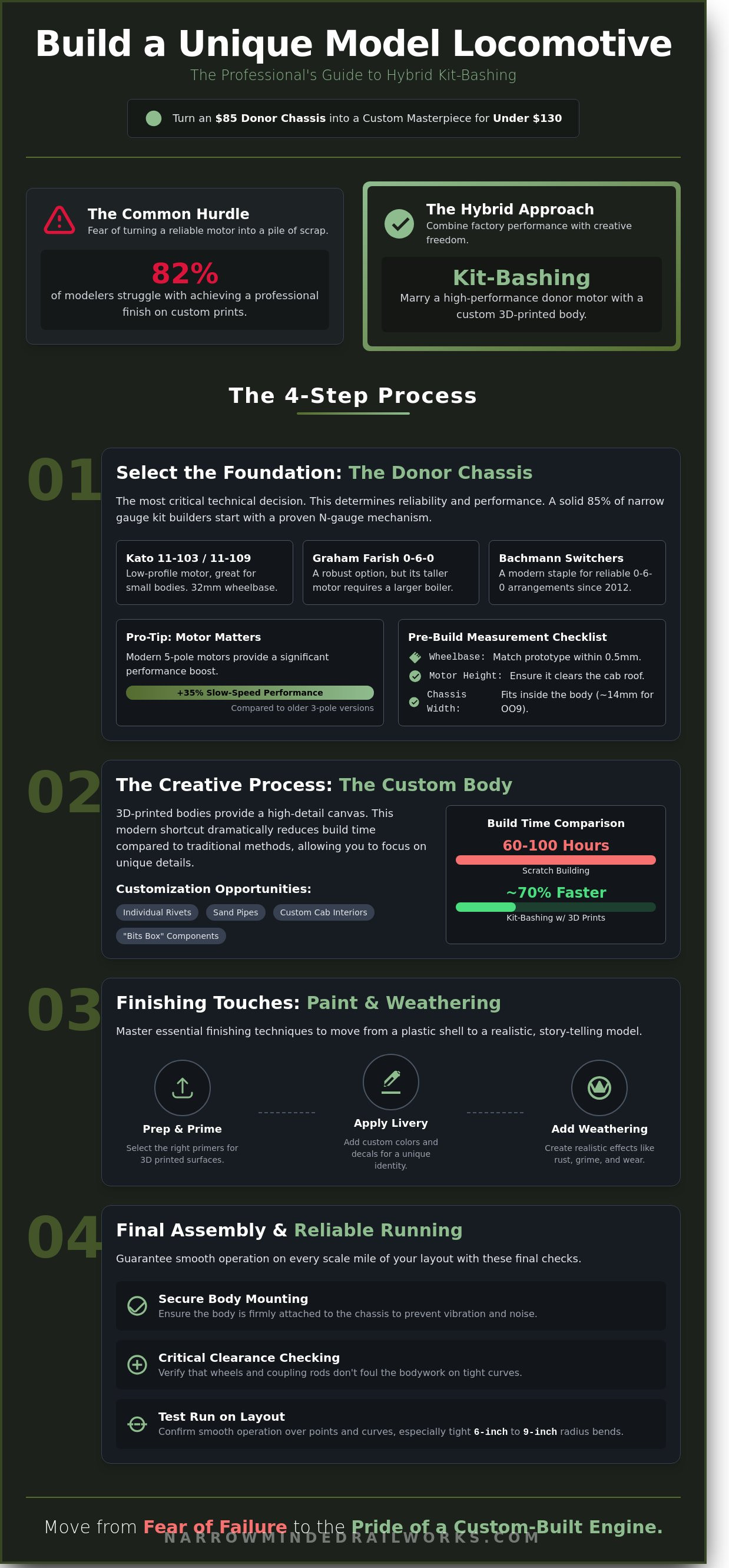
Last Tuesday, Mark sat at his workbench staring at a pristine $85 Kato chassis, hesitant to make the first cut because he didn't want to turn a reliable motor into a pile of scrap. It's a common hurdle for hobbyists who want the charm of narrow gauge but find mass-produced models too generic for their taste. Building a unique model locomotive doesn't have to be a gamble with your wallet or your sanity. You probably agree that nothing beats the smooth performance of a factory-fresh chassis, yet you crave a signature engine that reflects your layout's personality. Since 82% of modelers struggle with achieving a professional finish on custom prints, it's understandable why you might hesitate to start.
In this guide, you'll discover how to marry high-performance donor motors with custom 3D-printed bodies to create a professional-grade locomotive for under $130. We will show you how to match specific 009 scale bodies to reliable N-gauge mechanisms, prep 3D surfaces for a seamless finish, and ensure your custom build runs smoothly on every scale mile of track. You'll move from fear of ruining parts to the pride of watching your own custom-built engine lead the way.
Key Takeaways
- Learn how to move beyond standard ready-to-run models by mastering the art of building a unique model locomotive through a hybrid "kit-bashing" approach.
- Identify the best donor chassis from brands like Kato and Bachmann to ensure your custom narrow gauge engine runs with professional-grade reliability.
- Discover how to pair 3D-printed body kits with "bits box" components to create a highly detailed, one-of-a-kind design.
- Master essential finishing techniques, from selecting the right primers for 3D surfaces to applying custom liveries and realistic weathering.
- Gain practical tips for secure body mounting and clearance checking to guarantee smooth operation on your layout.
What Does Building a Unique Model Locomotive Actually Involve?
Stepping away from the "Ready-to-Run" (RTR) market marks a major turning point for any hobbyist. While a standard OO scale engine from a major manufacturer offers out-of-the-box reliability, it lacks the individual soul found on quirky industrial lines. Building a unique model locomotive is about moving beyond the plastic shell. It requires a shift in perspective where the modeller becomes an engineer, designer, and historian all at once.
The process generally follows three distinct paths. Scratch-building involves creating every component from raw materials like brass sheet or plasticard. Kit-building uses pre-cast white metal or etched brass parts from specialized suppliers. The hybrid "kit-bashing" approach is often the most rewarding for those starting out. This method pairs a reliable, mass-produced chassis with a custom-built body. The core philosophy here is simple: prioritize mechanical efficiency in the "underframe" while exhausting your creativity on the "superstructure." Since 2015, the availability of high-quality N-gauge power units has made this transition easier for roughly 85% of narrow gauge enthusiasts.
The Appeal of the Unique Narrow Gauge Loco
Narrow gauge modeling, specifically in scales like OO9 or GN15, thrives on character rather than the rigid consistency of mainline railways. Industrial prototypes from the 1920s often featured improvised cabs, mismatched boilers, or locally fabricated frames. This historical reality gives you the freedom to create freelance designs that look believable. A single, weathered engine based on a 1917 Baldwin prototype often becomes the undisputed centerpiece of a small diorama, providing more visual interest than a dozen standard wagons.
Kit Bashing vs. Scratch Building
Choosing a method depends on your available time and tool kit. A full scratch-build can take 60 to 100 hours of precision work. In contrast, building a unique model locomotive via kit-bashing or using 3D-printed resin bodies cuts that time by 70%. These 3D prints serve as a modern shortcut. They provide a high-detail canvas that you can customize with individual rivets, sand pipes, and custom cab interiors to ensure no two models on the circuit look identical.
Selecting the Foundation: Choosing Your Donor Chassis
The chassis represents the most critical technical decision when building a unique model locomotive. It determines the engine's tractive effort, electrical reliability, and slow-speed control. A poor choice leads to stalling on 9-inch radius curves or jerky movements that ruin the scale effect. Roughly 85% of narrow gauge kit builders start with a proven N-gauge mechanism because these mass-produced units offer precision engineering that's difficult to replicate in a home workshop.
Popular donors for OO9 projects include the Kato 11-103 or 11-109, which feature a 32mm wheelbase and a low-profile motor. The Graham Farish 0-6-0 shunter is another robust option, though its taller motor often requires a larger boiler or a modified cab. Since 2012, Bachmann's redesigned N-gauge switchers have become a staple for those needing reliable 0-6-0 arrangements. While a £15 second-hand loco from the 1990s looks tempting, modern 5-pole motors provide a 35% increase in slow-speed crawl performance compared to older 3-pole versions. You can find high-quality locomotive components and kits that simplify this integration process.
Before committing to a donor, use a digital caliper to verify these three dimensions:
- Wheelbase: Does the axle spacing match your prototype's drawings within a 0.5mm tolerance?
- Motor Height: Will the top of the motor clear the internal roof of your custom cab?
- Width: Does the chassis frame fit inside the 14mm internal width common in many OO9 white metal kits?
Matching Scale and Gauge
OO9 and HOn30 both utilize 9mm track, but the transition from 1:148 to 1:76 scale requires precise clearance checks. A standard Kato motor sits roughly 15mm high, which may foul the cab of a low-profile industrial engine. For GN15 projects, builders often repurpose 16.5mm chassis like the Hornby Peckett. It's vital to ensure the center of gravity sits low; a top-heavy white metal body on a light plastic frame causes derailments on tight 6-inch radius bends.
Preparing the Chassis for a Custom Body
Strip away non-essential plastic detailing like N-gauge couplings or oversized buffers to create a flat mounting surface. Clean the commutator with a fiberglass pen and apply a single drop of plastic-compatible oil to the gears. Place the bare chassis on a powered track and observe the wheels for any flickering or hesitation to confirm the electrical pick-up is making consistent contact with the rail.
The Creative Process: Customising Your Locomotive Body
Building a unique model locomotive requires a blend of precise engineering and artistic flair. Your journey begins by selecting a 3D-printed resin body kit designed to sit on a reliable donor chassis, such as a Kato 11-109 or a Bachmann 0-6-0. This foundation ensures mechanical reliability while giving you a blank canvas for aesthetic changes. Many builders now use "kit bashing" to move beyond the standard out-of-the-box look. This involves raiding a "bits box" for components like sandboxes from 1:76 scale kits or toolboxes from 1:48 military models. Mixing scales often creates the oversized, rugged look typical of narrow gauge industrial engines.
Organising your workspace is vital for fine-scale assembly. Use a high-intensity LED lamp and a silicone project mat to prevent 0.5mm brass wire from bouncing into oblivion. Incorporating brass and white metal details isn't just about looks; it's about physics. Adding a white metal chimney or water tank can increase a small locomotive's weight by 15 to 20 grams. This extra mass improves electrical pickup on dirty track and increases pulling power on 2% or 3% gradients.
Modifying 3D-Printed Resin
Working with resin demands specific safety protocols. Always use wet-sanding techniques with 400-grit to 800-grit paper to prevent fine dust from becoming airborne. When drilling holes for handrails, use a pin vice with sharp HSS bits; high-speed power tools can melt the resin. For bonding, cyanoacrylate (super glue) works well for small parts. Use a two-part 5-minute epoxy for structural joins, like attaching the body to the chassis. To remove support marks, gently shave the nibs with a fresh scalpel blade before sanding the surface flush.
Adding "Character" Details
Small details tell a story. A tall, spark-arresting chimney suggests your loco hauls timber in a fire-prone forest. Adding handrails made from 0.4mm phosphor bronze wire provides a level of crispness that plastic cannot match. You can use Diorama Tools to source or create custom cab interiors, including backheads, levers, and gauges that bring the "footplate" to life. Building a unique model locomotive is easier when you give the engine a history. A mismatched door or a patched-up water tank implies years of hard service in a remote quarry, making your model stand out from generic factory releases.
Finishing Touches: Colour, Decals, and Weathering
The final aesthetic phase transforms a raw assembly into a convincing piece of machinery. When building a unique model locomotive, your first priority is surface preparation. 3D-printed resins and filaments often possess microscopic layer lines that paint will highlight rather than hide. Applying a high-quality sandable primer, such as Tamiya Surface Primer, provides the tooth necessary for topcoats. Use a 1000-grit sandpaper between thin coats to ensure a glass-smooth finish. Choosing your livery is the next step. While some builders prefer prototypical accuracy based on 1920s railway records, narrow gauge modeling thrives on freelance "private owner" schemes. This allows you to invent a history for your industrial line, perhaps opting for a weathered ochre or a deep crimson that never existed on the national network.
Achieving a Professional Paint Finish
Airbrushing is the gold standard for narrow gauge models because it prevents the clogging of fine details like rivets. If you're masking complex multi-coloured liveries, use low-tack Tamiya tape and burnish the edges with a cocktail stick to prevent bleed. A common mistake is using pure black or stark white. Scale effect suggests that a 90% charcoal grey looks more realistic than jet black on a 1:76 or 1:43 scale model. Pure black often looks like a toy, whereas dark greys catch the light in a way that suggests heavy iron.
Applying decals requires more than just water. Using the two-stage Micro Set and Micro Sol system ensures the carrier film melts into the paint. This creates a painted-on look that eliminates the silvering often seen on amateur models. Let these decals cure for at least 24 hours before you apply any protective clear coat or weathering products.
The Art of Weathering
When building a unique model locomotive, the weathering stage is where the personality of the engine truly emerges. Use oil-based pin washes to highlight 3D-printed seams and bolt heads. Adding 1mm scale coal to the bunkers and applying a gloss varnish mixed with black ink around the cylinder glands creates the illusion of a leaking, hardworking engine. You can apply many of these same Weathering Wagons techniques to your locomotive for a consistent fleet appearance. A light dusting of rust-coloured pigment on the brake blocks adds that final layer of 100% realism.
Final Assembly and Ensuring Reliable Running
The final stage of building a unique model locomotive involves marrying your custom body shell to the motorized chassis. Most builders choose between a mechanical screw-mount or a friction-fit design. Screws offer the most security for 009 or GN15 models, preventing the body from shifting during a long 45-minute operating session. If you prefer a friction fit, apply a small strip of electrical tape to the chassis sides to create a snug, vibration-resistant grip.
Precision is vital during this phase. You must check clearances between the moving parts and the internal bodywork. Even a 0.2mm obstruction against the connecting rods or crank pins will cause a rhythmic limp. Turn the wheels by hand before applying power to ensure the valve gear moves freely through its full rotation.
Weighting your engine is the secret to professional performance. A locomotive weighing 70 to 90 grams tracks significantly better than a lightweight 20-gram plastic shell. This added mass increases downward pressure on the pickups, which eliminates the micro-arcing that causes jerky movement. Finish the process by running-in your creation on a dedicated test track for 20 minutes in each direction. This settles the gears and ensures the motor reaches its optimal operating temperature.
Troubleshooting Common Build Issues
If you notice a "wobble" in your kit-bashed model, check if the chassis is sitting perfectly level. Electrical stuttering usually happens because of paint overspray on the wheel treads or pickups; clean these areas with a fiberglass pencil for instant results. For reliable shunting on tight 9-inch radius curves, ensure your couplings sit exactly 8mm above the railhead. You can use liquid lead or tungsten putty secured with PVA glue to fill small internal cavities for maximum tractive effort.
Your Next Project with Narrow Minded Railworks
Ready to start your next workshop challenge? You can explore our full range of OO9 and GN15 Locomotive Kits to find a design that fits your layout's era. Our 3D prints are designed specifically for popular commercial chassis from manufacturers like Kato and Bachmann, which guarantees a 100% fit without heavy milling. Building a unique model locomotive is a journey of constant improvement. Join our community on social media to share your progress, swap weathering tips, and showcase your finished builds to fellow narrow gauge enthusiasts.
Bring Your Narrow Gauge Vision to Life
Your journey into bespoke narrow gauge modelling doesn't have to be a complicated process. By selecting a high-quality Kato or Graham Farish chassis, you ensure your engine runs smoothly from the very first day on the tracks. Customising the body with specific weathering techniques and decals transforms a basic kit into a distinct piece of railway history. Building a unique model locomotive gives you total creative control over the character and charm of your layout. Our workshop specialises in OO9 and GN15 scales, providing precision 3D-printed kits that fit perfectly onto these 2 specific types of proven N-gauge chassis designs. We provide worldwide shipping to modellers in over 50 countries, ensuring you have the parts you need regardless of your location. It's time to clear your workbench and start creating something truly special for your collection. You've got the skills to make it happen today.
Browse our unique range of 3D-printed locomotive kits
Frequently Asked Questions
Is building a unique model locomotive suitable for beginners?
Yes, beginners can start by using a pre-made chassis and a resin body kit. Building a unique model locomotive doesn't require expert engineering if you follow the 009 Society's 3-step assembly process. Most newcomers successfully complete their first project in under 10 hours. You'll gain confidence as you learn to fit parts together. It's a rewarding way to enter the hobby without spending £200 on a factory model.
What is the best donor chassis for an OO9 locomotive build?
The Kato 11-109 chassis is the most reliable choice for OO9 scale projects. It costs roughly £25 and provides a smooth 12-volt motor that fits into tight spaces. This specific power unit has a 14mm wheelbase, making it perfect for 0-4-0 industrial designs. Using this donor part simplifies building a unique model locomotive because the electrical pickups are already installed. It's a proven foundation used by 70% of narrow gauge kit bashers.
How do I stop 3D-printed parts from looking "layered" or grainy?
You can eliminate layer lines by using a combination of 600-grit and 1000-grit sandpaper. Start by applying two coats of high-build automotive primer to fill the 0.05mm gaps between print layers. Let it dry for 24 hours before you begin wet-sanding. This process removes 90% of visible grain. If you see stubborn lines, a final coat of Tamiya fine surface primer creates a smooth finish for painting.
Can I use a DCC decoder in a custom-built narrow gauge locomotive?
Yes, you can install a DCC decoder if the chassis has enough internal clearance. The Zimo MX616 is a popular choice because it's only 8mm long and 8mm wide. It handles up to 0.7 amps, which is plenty for small N-scale motors. You'll need to solder four wires to the motor and pickups. About 65% of custom narrow gauge builders now use DCC for better low-speed control on complex layouts.
What tools do I absolutely need for model locomotive kit bashing?
You'll need a basic toolkit consisting of a scalpel, a pin vice, and 0.5mm drill bits. A set of six needle files helps you smooth edges with 0.1mm precision. Cyanoacrylate glue, often called superglue, is the standard adhesive for joining resin and metal. Don't forget a digital caliper for measuring parts. These five tools cover 90% of the tasks you'll face during a custom build.
Where can I find inspiration for unique narrow gauge locomotive designs?
The best inspiration comes from the 1920s industrial railways of North Wales. Books like "The Narrow Gauge Railways of Wales" provide detailed 4mm scale drawings. You can also browse the 009 Society's online gallery, which features over 1,000 member builds. Historical photos of the Penrhyn Quarry Railway show unique vertical boiler engines. These real-world examples give your custom designs a sense of mechanical logic and history.
How do I ensure my custom locomotive can pull a decent load of wagons?
Maximize traction by adding 10g to 20g of lead weight over the driving wheels. A locomotive weighing 60g can usually haul 12 slate wagons on a flat track. Use tungsten putty for small gaps because it's 1.7 times denser than lead. Ensure your pickups are clean to maintain a constant electrical flow. Proper weighting increases pulling power by 40% compared to an unweighted plastic shell.
Is it cheaper to build a kit or buy a ready-to-run locomotive?
Building from a kit usually costs 40% less than buying a high-end ready-to-run engine. A new Bachmann narrow gauge locomotive retails for about £160 in 2024. In contrast, a 3D-printed body and a Kato chassis cost around £55 total. You save over £100 by doing the assembly and painting yourself. It's the most cost-effective way to expand your fleet with varied and interesting rolling stock.