

You've laid the track, your little engine is chuffing along nicely, but the world it lives in feels... empty. Making the leap from a bare baseboard to a living, breathing landscape can feel daunting, especially when faced with the vast array of narrow gauge scenery kits. Which buildings truly suit a Welsh slate quarry theme? Can you really use an HO-scale cottage on an OO9 layout? And what on earth is the difference between a laser-cut wood kit and a 3D-printed one? It’s enough to leave any modeller feeling overwhelmed and stuck for inspiration.
Fear not! This guide is your essential starting point for transforming that blank canvas into a captivating miniature world. We will walk you through choosing, building, and arranging the perfect scenery to tell your railway's unique story. You’ll gain the confidence to select the right kits for your theme, understand the basics of assembling different materials, and find those characterful details that make a layout truly stand out. Let’s bring your narrow gauge vision to life!
Key Takeaways
- Learn to capture the unique atmosphere of narrow gauge railways by focusing on the typical industrial, rural, and pioneering environments.
- Select the perfect narrow gauge scenery kits for your layout by understanding how to correctly match scale (like OO vs OO9), material, and style.
- Break down your layout planning into manageable steps by learning the essential categories of scenery, from major buildings to small lineside details.
- Gain the confidence to build and finish any kit, including modern 3D printed models, with our beginner-friendly guide to assembly and painting.
What Makes Scenery 'Narrow Gauge'? Capturing the Right Atmosphere
Creating a convincing narrow gauge layout is about more than just the distance between the rails. It’s about capturing a unique atmosphere-one of intimacy, purpose, and often, a struggle against the landscape. Unlike their mainline counterparts, which were built to connect major cities, most narrow gauge railways were constructed for a specific, localised job. This purpose is the heart of your model's story, and the scenery is how you tell it.
These railways were often built on a tight budget to serve remote industries or rural communities where a standard gauge line would be too expensive or impractical. To understand the history and variety, it's helpful to ask, What is a narrow-gauge railway? Their very nature-hugging tight curves, climbing steep gradients, and squeezing through small spaces-dictates a scenery that is detailed, characterful, and closely integrated with the track itself.
Seeing a classic structure can help illustrate this unique character. This video shows the assembly of a water tower kit, a typical feature on many industrial and rural lines:
Defining the Narrative of Your Railway
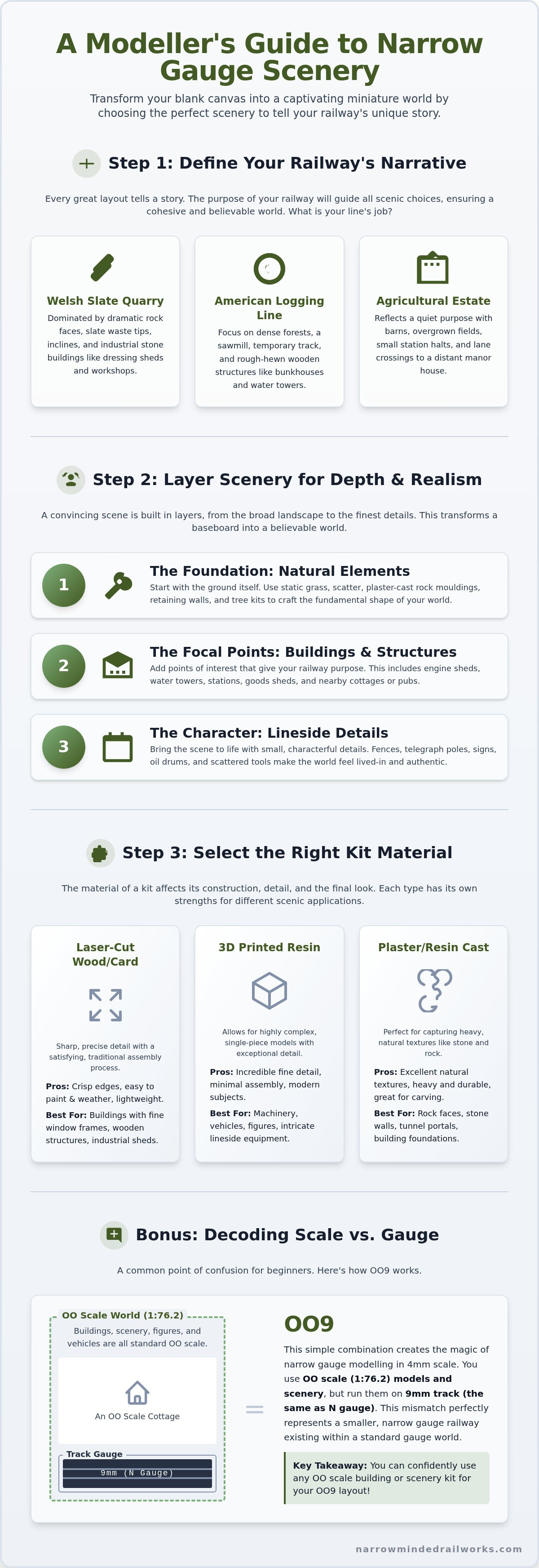
Every great layout tells a story. Before you buy a single kit, decide on the purpose of your railway. This narrative will guide all your scenic choices, ensuring a cohesive and believable world. Is your line:
- A Welsh slate quarry line? Your scenery will be dominated by dramatic rock faces, slate waste tips, inclines, and industrial stone buildings like dressing sheds and workshops.
- A logging railway in the American wilderness? Focus on dense forests, a sawmill, temporary track, and rough-hewn wooden structures like bunkhouses and water towers.
- A small agricultural estate line? Choose scenery that reflects this, such as barns, overgrown fields, small station halts, and perhaps a lane crossing to a distant manor house.
Key Visual Themes in Narrow Gauge
While every prototype is different, certain visual themes recur across narrow gauge railways, and the right narrow gauge scenery kits help bring them to life. Look for elements that convey:
- Industrial Grit: These were working railways. Think of grimy engine sheds, cluttered workshops, coal staithes, and mineral workings. The scenery should look functional, not pristine.
- Rural Charm: Many lines passed through quiet countryside. Small stone cottages, a village pub, overgrown trackside vegetation, and dry-stone walls create a sense of a railway that is part of the landscape, not imposed upon it.
- Makeshift & Temporary Structures: Reflecting their low-cost origins, many narrow gauge lines featured buildings made from corrugated iron, rough-sawn timber, and recycled materials. Simple huts and shelters add immense character and authenticity.
Essential Types of Scenery Kits for Your Layout
Breaking down your layout's scenery into distinct categories makes the entire process feel less daunting. The key to a convincing scene is layering, starting with the broad landscape and progressively adding finer details. When selecting narrow gauge scenery kits, thinking in terms of these layers helps you build depth and realism, transforming a simple baseboard into a believable world. Kits that create large visual footprints, like buildings and terrain, often provide the most impact for your time and budget.
Buildings & Structures: The Focal Points
These kits provide the main points of interest and give your railway a purpose. They can be broken down into three main types:
- Operational Buildings: Engine sheds, water towers, and signal boxes are essential for the functioning of your line.
- Lineside Structures: Small stations, platform shelters, and goods sheds add character and operational interest along the track.
- Off-Railway Buildings: A trackside pub, a row of miners' cottages, or a small workshop helps create a complete scene and explains why your railway exists.
Natural Elements: Crafting the Landscape
This is the foundation of your miniature world. Start with ground cover, using static grass and various scatter materials to create realistic fields, verges, and footpaths. Introduce topography with plaster-cast rock mouldings or ready-made retaining walls and embankments. Finally, use tree and foliage kits to add height, texture, and define the season, whether it's the lush green of a Welsh valley in summer or the sparse branches of an autumnal Scottish glen.
The Finishing Touches: Detail Kits
These small elements are what truly bring a layout to life. Lineside clutter kits add authenticity with items like stacked sleepers, oil drums, tool kits, and signage. Many kits are designed to high standards of accuracy, often following best practices established by organisations like the National Model Railroad Association (NMRA), ensuring they look right alongside your rolling stock. Adding carefully painted figures, animals, and era-appropriate vehicles like a vintage delivery lorry completes the story and adds a sense of purpose and movement.
Choosing the Right Kits: Scale, Material, and Style
With a plan in place, selecting the right kits is the next exciting step. This decision hinges on three key factors: scale compatibility, the material of the kit, and the overall style you want to achieve. Getting these elements right is crucial for building a miniature world that is both convincing and a joy to create. Making informed choices now will save you time and money later, ensuring your layout looks cohesive.
Understanding Scale Compatibility
One of the most common points of confusion for newcomers is the relationship between OO and OO9. Both are 4mm scale (4mm on the model equals 1 foot in real life). The difference is the track gauge: standard gauge OO uses 16.5mm track, while narrow gauge OO9 uses 9mm track. Because the scenic scale is identical, you can confidently use most OO scale buildings, figures, and road vehicles on your OO9 layout. In fact, using slightly smaller OO structures can enhance the perception that your railway is a small, narrow gauge operation.
Comparing Kit Materials: What to Expect
The material of your chosen narrow gauge scenery kits dramatically affects the building experience and final look. Each has its own strengths:
- 3D Printed Resin: Offers exceptional detail and allows for unique, specialised models not found elsewhere. Kits require a thorough wash to remove residue and a coat of primer before painting, but the crisp results are worth the effort.
- Laser-Cut Wood/MDF: These kits often slot together with precision, making assembly straightforward. The material provides a wonderful natural texture, perfect for wooden structures like engine sheds, huts, and fences.
- Plastic Injection Mould: Widely available from major brands, these kits are easy to glue with polystyrene cement. They can sometimes lack fine texture, so effective painting and weathering are key to achieving a realistic finish.
- Cast Resin/Plaster: Ideal for scenery with heavy textures like stone walls, rock faces, and bridge abutments. These kits can be heavy, so ensure your baseboard can support them.
Matching Kits to Your Chosen Theme
A believable model railway tells a consistent story. Ensure your buildings and details fit the location and era you are modelling. A layout based on a Welsh slate quarry should feature structures with slate roofs and stone walls, not the red brick common in the English Midlands. Pay attention to the small details, too-do the barrels, tools, and signage match your railway's purpose and time period? To bring your scene to life, details are everything. Browse our collection of OO9 scenery kits for unique, 3D printed details that can define your layout's character.
Bringing Your Kits to Life: Basic Building & Finishing
Unboxing your model is just the beginning; the real magic happens on the workbench. Transforming your narrow gauge scenery kits from printed parts into realistic, characterful structures is an immensely satisfying process. Don't be intimidated by the thought of painting or assembly. With a few basic tools and simple techniques, you can achieve results that bring your entire layout to life.
Essential Tools for Building Scenery Kits
You don’t need a state-of-the-art workshop to get started. A small, dedicated space and a handful of essential items will see you through countless projects. Most of these can be found at local UK hobby shops or online for a modest initial investment.
- Assembly Must-Haves: A sharp craft knife (with spare blades), a self-healing cutting mat, fine-tipped tweezers for handling small parts, and a good quality superglue (cyanoacrylate).
- Painting Basics: A starter set of acrylic paints from brands like Humbrol or Vallejo, a few fine-detail brushes (sizes 00 to 2 are ideal), and a spray can of matt grey or white primer.
- Finishing Touches: Pre-made dark washes (e.g., black or brown) and a small selection of weathering powders for creating realistic rust, soot, and dust effects.
A Simple Workflow for 3D Printed Kits
Modern 3D printed resin kits are designed for a straightforward and enjoyable build. Follow these four simple steps for a flawless finish every time.
- Clean the Print: Gently wash the model in warm, soapy water using an old, soft toothbrush. This removes any residual resin from the printing process and ensures your primer will adhere perfectly. Allow it to air dry completely.
- Remove Supports: Carefully snip away the support structures with a pair of hobby clippers or a sharp craft knife. Work slowly to avoid damaging any fine details.
- Apply Primer: In a well-ventilated area, apply a light, even coat of spray primer. This crucial step unifies the surface texture and gives your paint a fantastic base to stick to.
- Paint and Detail: Begin by applying your main base colours. Once these are dry, use a finer brush to pick out the smaller details like window frames, door handles, and brickwork. Don’t worry about being perfect-the next step will hide minor mistakes!
The Magic of Weathering
Weathering is what turns a clean model into a believable part of your miniature world. It’s the art of adding grime, rust, and wear to mimic the effects of time and the elements. A simple dark wash is a game-changer for beginners; just brush it over your painted model and watch as it settles into crevices, instantly adding depth and shadow. For dust or rust, dab a small amount of weathering powder onto key areas with an old brush. These simple touches are what elevate good narrow gauge scenery kits into truly exceptional centrepieces for your layout.
Ready to start your next project? Explore our full range of detailed kits at Narrow Minded Railworks.
Your Narrow Gauge Journey Starts Here
Building a captivating narrow gauge layout is more than just track and trains; it’s about crafting a believable world in miniature. As we've explored, the key lies in capturing that unique, often rustic, atmosphere and carefully selecting kits that match your scale and desired style. The real joy comes from the building and finishing process, turning simple components into the detailed structures that bring your scene to life.
If you're ready to populate your world, our collection of narrow gauge scenery kits offers the perfect next step. Every model is designed and produced in-house, leveraging high-resolution 3D printing for maximum realism and detail that truly stands out. We are proud to offer these unique models and provide worldwide shipping for modelers everywhere.
Take your layout to the next level. Explore our full range of unique narrow gauge scenery kits today and find the perfect centrepiece for your scene. Happy modelling!
Frequently Asked Questions
Can I use standard OO or HO scale scenery kits for my OO9 narrow gauge layout?
Yes, absolutely. OO9 uses 4mm scale models (the same as OO gauge) running on 9mm track. Therefore, any buildings, figures, vehicles, and scenic accessories designed for OO scale are perfectly sized for your layout. While HO scale (3.5mm) kits are slightly smaller, they can often be used effectively in the background to create a sense of distance through forced perspective. Just be sure to avoid N gauge kits, which will be far too small.
What are the best types of glue to use for 3D printed resin scenery kits?
The best adhesive for 3D printed resin is superglue, also known as cyanoacrylate (CA) glue. A medium viscosity superglue offers a good balance of setting time and strength for most parts. For joining larger, heavier components or filling small gaps, a two-part epoxy adhesive will provide a much stronger bond. Always ensure you are working in a well-ventilated space when using these types of glue. PVA glue is not suitable for resin.
How do I start planning the scenery for my model railway?
Begin by thinking about the story and location of your railway. Is it a Welsh slate quarry, a Cornish clay works, or a rural estate line? Sketch a rough plan on paper, marking out major features like hills, rivers, roads, and the placement of key buildings. Consider sightlines and how you can use scenery to frame views and hide non-prototypical elements like fiddle yards or the edge of the baseboard. This plan becomes your roadmap for purchasing materials.
Are laser-cut wood kits or 3D printed kits better for a beginner?
Both kit types are great for beginners, but they offer different experiences. Laser-cut wood kits are often easier to assemble, fitting together like a jigsaw with PVA wood glue, and are very forgiving to work with. 3D printed resin kits can provide superior fine detail straight from the box but may require more preparation, such as removing support marks, and require the use of superglue. A simple laser-cut wooden building is often a fantastic first project.
Where can I find figures and people that are the right scale for my OO9 layout?
Because OO9 is a 4mm scale, you should look for standard OO scale (1:76) figures. Many UK-based manufacturers like Hornby, Bachmann, and Dapol offer a wide selection of people and animals. For more specific characters or higher detail, look at specialist brands such as Modelu, Dart Castings, or P&D Marsh. These figures will be perfectly scaled to stand alongside your locomotives, rolling stock, and any of the narrow gauge scenery kits you build.
How much scenery do I need to make my layout look complete?
This depends entirely on the scene you are modelling. A dense industrial yard will require many more buildings and details than a sparse, open moorland landscape. The goal is to cover the entire baseboard so no bare wood is visible. Start with the foundational elements: a basic ground cover, a scenic backscene, and one or two key structures. You can then gradually add layers of detail like trees, fences, and clutter over time to bring it to life.