

What if the most intimidating stage of your narrow gauge build was actually the most rewarding? Many modellers spend weeks meticulously assembling an OO9 or O-16.5 kit, only to let it sit in grey primer because they fear a shaky hand will ruin the finish. It's a common frustration; 3D printed resin presents unique adhesion challenges, but the right primer and surface preparation can create a flawless canvas. You don't have to settle for visible support marks or paint that flakes off during handling.
We understand that painting and lining a locomotive kit feels like a high-stakes gamble where one slip of the pen destroys hours of work. However, professional results are accessible to everyone when you use techniques tailored for modern materials. This guide will teach you how to achieve a smooth base coat and apply crisp, factory-standard lining that survives regular use on your layout. We will examine the best tools for the job, discuss how to navigate the August 2026 formaldehyde emission regulations for coatings, and provide a step-by-step workflow for a durable, professional finish.
Key Takeaways
- While 3D printed resin requires specific handling, proper surface preparation and specialized primers create a smooth foundation for a flawless finish.
- Traditional lining is often viewed as a complex skill, but using physical guides and modern masking tape makes painting and lining a locomotive kit accessible for any modeller.
- Although professional tools offer high precision, you can select effective lining methods that align with your specific budget and skill level.
- While a clean paint job looks professional, applying realistic weathering and transfers helps your narrow gauge model feel like an authentic, working engine.
- Protecting your work is essential, so choosing the right varnish ensures your locomotive survives assembly and regular layout handling without damage.
Surface Preparation: Preparing Your 3D Printed Kit for Paint
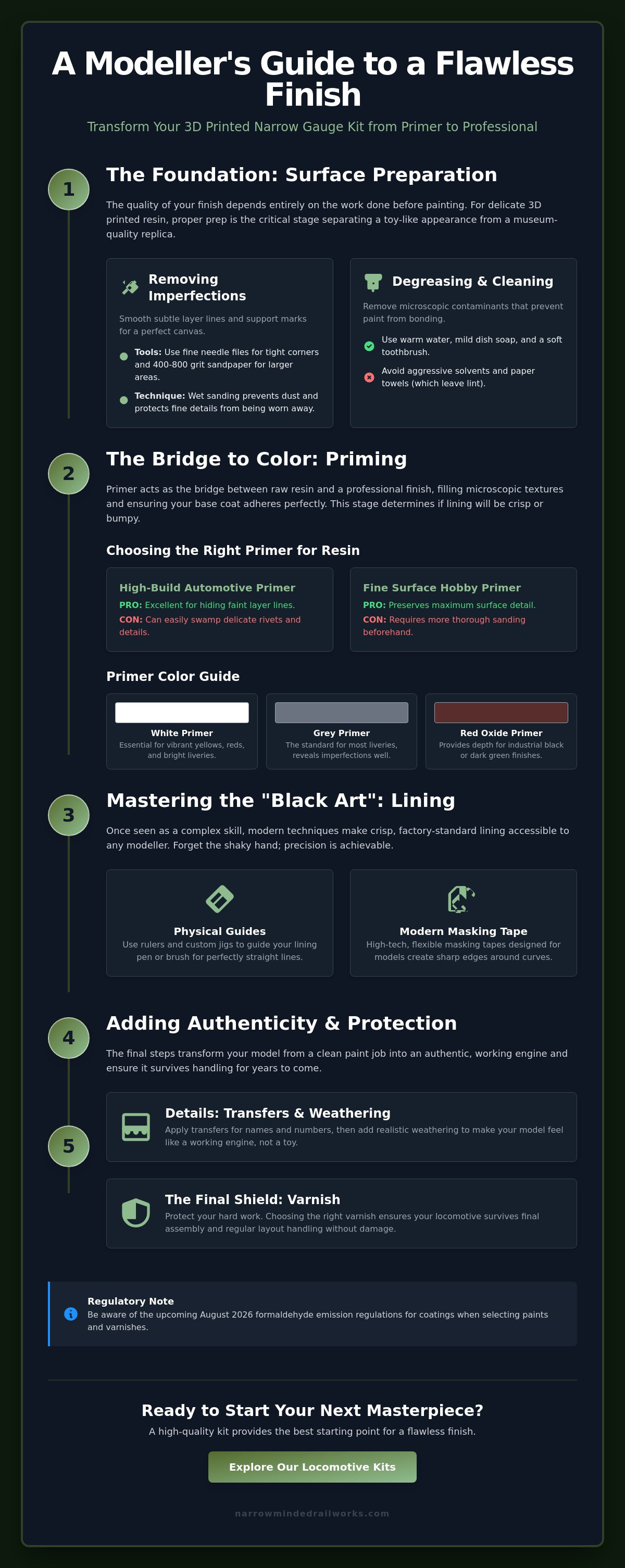
Preparing a 3D printed resin kit is fundamentally different from working with traditional white metal or brass. While metal kits often require aggressive scrubbing to remove heavy mold release, resin models are more delicate and slightly porous. When painting and lining a locomotive kit, the quality of your finish depends entirely on the work you do before the airbrush even comes out. In the broader model railroading hobby, surface prep is the critical stage that separates a toy-like appearance from a museum-quality replica. Resin is brittle and prone to surface imperfections, but following a structured preparation workflow ensures your base coat adheres perfectly.
To better understand how to prepare a surface by removing imperfections, watch this helpful video:
3D prints often feature subtle layer lines or support marks that are nearly invisible to the naked eye until they are highlighted by a coat of paint. You must address these early to achieve a professional result. Using the right tools allows you to smooth the surface without damaging fine details like rivets or boiler bands.
Removing Support Marks and Smoothing Layer Lines
Support marks appear as tiny pips or craters where the printer built temporary structures. If you ignore these, they'll ruin the crispness of your final lining. Use fine needle files for tight corners on OO9 locomotive bodies where sandpaper cannot reach. For larger areas, wet sanding with 400 to 800 grit paper is the most effective approach. The water prevents resin dust from clogging the grit and keeps the surface cool, which ensures you don't accidentally sand away delicate features. Look closely for "hidden" support nubs under the footplate or inside the cab, as these often become glaringly obvious once you apply a primer.
Degreasing and Cleaning the Locomotive Body
Resin surfaces frequently retain microscopic traces of liquid resin or cleaning agents from the manufacturing process. These contaminants prevent paint from bonding, leading to peeling later on. While some modellers use aggressive solvents, these can soften the thin walls of a 7mm or 4mm scale kit. Instead, use warm water mixed with a mild dish soap and a soft toothbrush. This removes oils without risking the structural integrity of the plastic. Once you have scrubbed the model, let it air dry in a dust-free environment. Avoid using paper towels or cloths, as they leave behind tiny lint fibers that will show up under your base coat.
Priming and Base Coating for a Smooth Finish
Once the resin is clean and sanded, the primer acts as the bridge between raw material and a professional finish. It fills microscopic textures inherent in 3D printing that would otherwise mar your final livery. Using proper tools for model painting, such as a dedicated spray booth and high-intensity lighting, helps you spot imperfections before they're sealed. If you're painting and lining a locomotive kit, this stage determines whether your lining will sit on a flat surface or a bumpy one. A textured surface makes it impossible to achieve the crisp, straight lines seen on factory-finished models.
Choosing the Right Primer for Resin Kits
You'll need to decide between high-build automotive primers and fine surface hobby primers. High-build options are excellent for hiding faint layer lines, but they can easily swamp delicate rivets on a 4mm or 7mm scale model. Fine surface primers preserve detail but require more thorough sanding beforehand. Always test your primer on a piece of scrap support material first to check for chemical reactions. Grey primer is the standard for most liveries, but red oxide provides a historically accurate depth for industrial black or dark green locomotives. If you're aiming for a bright yellow or red livery, a white primer is essential to ensure the color remains vibrant. Selecting a high-quality OO9 or O-16.5 locomotive kit provides a better starting point, as well-engineered prints require less filler-primer to look smooth.
Applying the Base Coat: Spray vs. Brush
An even base coat is easiest to achieve with an airbrush or a high-quality rattle can. The "light coat" rule is vital here. It's better to apply three thin, misty layers than one heavy one. Heavy coats tend to pool around the base of saddle tanks or inside cab corners, obscuring the very details that make narrow gauge kits charming. Give each layer at least ten minutes to "flash off" before applying the next. This prevents the wet paint from running or sagging on vertical surfaces. This process is particularly important for models with complex boiler plumbing or intricate cab interiors.
If you don't have access to spray equipment, you can brush-paint small details effectively. Use a wide, flat brush with soft bristles and thin your paint significantly. This prevents visible brush strokes and allows the paint to level out naturally. Focus on complex shapes first. Cabs and interiors should be painted before the final exterior pass to ensure you don't leave tide marks on the outer shell. Patience at this stage ensures the surface is perfectly prepped for the delicate work of lining that follows.
Mastering the "Black Art" of Lining
Lining is often regarded as the most intimidating stage of model making. While traditionalists might claim that hand-painting with a brush is the only "true" method, modern tools have made professional results accessible to every modeller. When painting and lining a locomotive kit, the goal is to create crisp, consistent borders that define the locomotive's shape. If you feel your hands aren't steady enough for freehand work, you can utilize physical guides and specialized tools to bridge the gap between a beginner's effort and a factory finish.
The secret to success lies in your choice of guides. Tamiya masking tape is an industry standard for creating straight edges. As of June 2026, a 2mm roll has an MSRP of $4.60 USD, while a 6mm roll is priced at $6.00 USD. These tapes are thin enough to conform to the curves of a narrow gauge boiler without allowing paint to bleed underneath. By laying two strips of tape parallel to each other, you create a "channel" that allows you to apply paint with confidence. If you make a mistake, you can wipe away acrylic-based lining from an enamel base coat using a damp cloth without damaging the underlying livery.
Bow Pens, Paint Pens, and Lining Decals
Traditional bow pens offer the most control over line width, but they have a steep learning curve. You must thin your paint, such as Humbrol Enamel, to a milky consistency to ensure a smooth flow. If this feels too technical, modern acrylic paint pens like those from Posca are excellent alternatives. They provide a constant flow of pigment and feel as natural to hold as a standard felt-tip. For complex corners or intricate crests on cab sides, lining decals (transfers) are often the best choice. They allow you to slide a perfectly printed line into position, which is much easier than trying to navigate a pen around a tiny 3D printed rivet.
The Lining Workflow: Planning Your Livery
Never start lining without a plan. Use a soft lead pencil to lightly mark your intended runs on the model. These marks are easily erased but provide a vital roadmap for your tools. Follow a logical order of operations to avoid smudging wet paint:
- Start with boiler bands, as these are the most prominent features.
- Move to the cab sides and bunkers.
- Finish with the buffer beams and small valance details.
To steady your hand, use the "mahlstick" technique. Rest your painting hand on a sturdy block of wood or a rod held in your other hand. This provides a stable pivot point, which is essential for the delicate scales of OO9 or O-16.5 models. While it takes patience, this structured approach ensures your lining looks intentional rather than accidental.
Adding Details: Transfers and Weathering
After you have finished painting and lining a locomotive kit, the model can look slightly sterile. In the narrow gauge world, locomotives were industrial tools that worked in harsh environments. Adding names, numbers, and a layer of grime transforms a plastic model into a convincing piece of machinery. This stage is where you decide the personality of your engine. You might choose an exhibition finish that looks like a preserved railway locomotive on a Sunday morning. Alternatively, you can opt for a quarry finish that reflects decades of hard labor. Both styles require a careful approach to transfers and weathering to avoid obscuring the fine details you worked so hard to preserve.
While transfers provide a professional look for names and numbers, they can sometimes look like stickers if applied incorrectly. You must create a smooth surface for the film to bond with. A gloss varnish is the best solution for this problem. It prevents air from being trapped under the decal, which causes a distracting silvering effect. Once you've applied your transfers, you can browse our range of locomotive kits to find the perfect companion for your newly detailed engine.
Perfect Decal Application with Micro Sol
3D printed models often feature intricate rivet patterns that make decal application difficult. While standard water can't make a decal conform to these bumps, specialized chemicals can. You can learn how to use micro sol for perfect decals to achieve a painted-on look. This solution softens the decal film, allowing it to shrink over rivets and into panel lines. Once the decal is dry, apply another thin coat of varnish to seal the edges. This prevents the transfer from peeling during handling or when you apply weathering washes later in the process.
Weathering Your Narrow Gauge Locomotive
Weathering is the art of telling a story through dirt. You don't want to simply cover the model in brown paint. Instead, identify where soot, grease, and rust naturally accumulate on a working engine. Soot builds up around the chimney and cab roof. Grease collects around the cylinders and running gear. While it's tempting to go overboard, a subtle approach usually yields the best results. You can reference our beginners guide to weathering wagons to ensure your locomotive matches the rest of your rolling stock. Using a combination of dry-brushing and weathering powders allows you to build up layers of texture without hiding the work you put into painting and lining a locomotive kit.
Final Assembly and Protecting Your Work
Completing the process of painting and lining a locomotive kit is a significant milestone, but the work isn't finished until the model is protected. Raw paint and delicate transfers are susceptible to damage from skin oils and physical abrasion. While it's tempting to immediately place your engine on the track, you must first apply a clear varnish to seal everything together. This final layer acts as a shield, ensuring your hard work remains pristine during years of layout operation. Without this protection, even light handling can cause the edges of your lining to lift or the base coat to wear thin on sharp corners.
Varnishing for Durability and Look
Choosing the right sheen is a subjective decision that affects the perceived scale of your model. While gloss varnish is useful for applying decals, it often looks unrealistic on a finished narrow gauge engine. Satin is frequently the preferred choice as it mimics the slight oily sheen of a well-maintained locomotive. If you want a hard-working industrial look, a matt varnish is better. However, you must be careful with environmental conditions. High humidity can cause "blooming" or clouding, which turns your clear coat into a milky mess. To avoid this, only spray in a dry, room-temperature environment and apply several light mists rather than one heavy layer.
Reassembling the body onto its chassis presents a final hurdle where many modellers accidentally chip their paint. While the varnish is dry to the touch within an hour, it can take several days to fully cure and harden. Use a soft foam cradle or a lint-free cloth to support the model during reassembly. If the fit is tight, don't force the components. It's better to lightly sand the hidden interior contact points than to risk scratching the exterior livery. Maintaining your locomotive involves occasional dusting with a soft makeup brush, which prevents grime from becoming embedded in the finish over time.
Next Steps: Expanding Your Narrow Gauge Fleet
Once you've mastered painting and lining a locomotive kit, you can apply these same professional techniques to other parts of your railway. The skills you've developed for surface preparation and finishing are perfectly transferable to OO9 wagon kits, where weathering plays an even larger role. If you're looking for a change in perspective, you might enjoy exploring GN15 scale, which offers more room for creative detailing on a larger footprint. Whether you're building a tiny industrial shunter or a large quarry engine, the key is a patient, structured approach to finishing. We invite you to browse our latest 3D printed locomotive bodies to find your next workshop project.
Bring Your Narrow Gauge Fleet to Life
While the prospect of finishing a model can feel daunting, professional results come from a structured approach rather than innate talent. You've learned that thorough degreasing and sanding provide the necessary foundation for any base coat. You also now understand that modern tools like masking tapes and acrylic pens remove the mystery from the "black art" of lining. Mastering the process of painting and lining a locomotive kit transforms a simple resin shell into a characterful centerpiece for your layout. It's about patience and using the right techniques for modern materials.
We're here to support your next project with high-detail 3D prints optimized for easy painting. Our kits are designed by modellers for modellers, ensuring every rivet and boiler band is crisp and ready for your brush or airbrush. With worldwide shipping available, your next build is only a few clicks away. Browse our range of 3D printed OO9 and GN15 locomotive kits today to find your engine. Take your time, trust the process, and enjoy the satisfaction of seeing your finished locomotive head out on its first run.
Frequently Asked Questions
Do I need an airbrush to paint a locomotive kit?
You don't need an airbrush to achieve a professional finish. While an airbrush offers the most control, high-quality aerosol cans and thinned brush-painting are perfectly effective alternatives for narrow gauge models. If you choose to brush-paint, using a self-leveling paint and applying multiple thin layers will help you avoid visible strokes and keep the surface smooth.
How do I get paint to stick to a 3D printed resin kit?
The key to adhesion is thorough degreasing and using the right primer. Although resin can be stubborn, scrubbing the model with warm soapy water removes residual oils that prevent bonding. Applying a dedicated plastic or automotive primer creates the necessary surface tension for painting and lining a locomotive kit without the risk of the finish peeling during handling.
What is the best tool for lining a small OO9 locomotive?
Acrylic paint pens with a 0.7mm or 0.5mm tip are generally the most accessible tools for small scales like OO9. While traditional bow pens provide a classic look, they require a steep learning curve and precise paint thinning. Using a paint pen combined with Tamiya masking tape allows you to create straight, consistent lines with much less physical strain.
Should I paint the locomotive before or after fitting it to the chassis?
You should always paint the body shell before you perform the final assembly on the chassis. Although it's tempting to see the completed engine, painting parts separately prevents overspray from gumming up the motor or gears. This approach also makes it easier to reach complex areas like the interior of the cab and the underside of the footplate.
How do I remove paint if I make a mistake during lining?
If you catch a mistake while the paint is still wet, you can wipe it away with a damp cotton bud. If you've applied acrylic lining over a cured enamel base coat, you can use a tiny amount of acrylic thinner to remove the error without damaging the underlying livery. This safety net makes painting and lining a locomotive kit far less stressful for beginners.
What kind of varnish should I use for a narrow gauge model?
Satin varnish is the most popular choice because it provides a realistic, slightly oily sheen that fits the industrial nature of narrow gauge railways. While matt varnish is excellent for heavily weathered engines, gloss should typically be reserved for the stage where you apply transfers. Always check that the humidity is low before spraying to prevent the varnish from turning cloudy.
How long should I wait between coats of paint?
You should wait approximately 15 to 20 minutes for a thin coat to "flash off" before applying the next layer. However, you shouldn't attempt to handle the model or apply masking tape for at least 24 to 48 hours. Rushing the curing process can trap solvents under the surface, which eventually leads to bubbling or a finish that remains permanently soft.
Can I use automotive spray paint on 3D printed kits?
Automotive primers and paints are excellent for resin kits, but you must apply them in very mist-like layers. While these paints are durable and cost-effective, they're designed for full-sized vehicles and can easily swamp fine details like rivets if applied too heavily. Always test the paint on a piece of scrap support resin first to ensure the solvents don't react with the plastic.