

The most convincing GN15 figure isn’t necessarily the one with the most dramatic pose. A person who’s too tall for a cab or facing the wrong way can look out of place, even when the model is detailed. Because GN15 combines G-scale figures with 16.5 mm track to represent a 15-inch-gauge railway, choosing gn15 figures can raise questions about both proportions and placement.
Compare more than the scale label: height, posture and the role a figure appears to have all affect how naturally it fits your scene. This guide covers choosing people for locomotive crews, yard work, buildings and smaller scenic cameos, so each figure has a clear place on your layout.
We’ll look at how to assess figure height against locomotives and structures, match seated, standing and action poses to their setting, and use product descriptions to narrow down the options. With 72 figures in the collection, including designs made from 3D scans of real people, a little planning can help you create a more varied and believable railway scene.
Key Takeaways
- Judge a figure alongside nearby locomotives, buildings and equipment to see whether its proportions feel convincing.
- Choose a pose that supports the scene’s purpose, from a working crew member to a quieter cameo.
- Use stated heights and suggested scene roles to compare gn15 figures and narrow your options.
- A seated figure may offer more placement options, while a specific action pose can make a scene feel purposeful but suit fewer locations.
What Are GN15 Figures, and What Do They Add to a Layout?
GN15 figures are people chosen to populate GN15 railway scenes, from locomotive crews to workers and bystanders. They do more than add detail: a well-placed person helps explain what is happening and gives nearby trains, buildings and scenery a sense of scale.
GN15 combines G-scale modelling with 16.5 mm track to represent a 15-inch-gauge railway. For a concise overview of the format, see What is GN15 scale. The figure listings describe their people as G-scale figures also suitable for GN15, but the scale label alone won’t tell you how a particular figure will look beside your locomotive or in your scene.
Scale, pose and placement work together: choose a figure that looks proportionate beside nearby models and whose posture makes sense in the scene.
How G-Scale Figures Relate to GN15 Modelling
A stated scale describes a model’s relationship to its real-world subject; a height in millimetres gives the figure’s physical measurement. These details answer different questions. The scale label helps establish suitability, while a listed height lets you compare the figure with a cab, doorway or platform edge. Selected figure listings provide approximate heights and suggested uses, so treat those details as a starting point rather than relying on the category label alone.
Compare the figure with the models around it. Someone beside a locomotive should look plausible in relation to the cab and running gear, while a person near a building should look in proportion to its doors and windows. Stock, structures and scenery all influence the visual effect, so consider the full grouping rather than judging the figure in isolation.
Why Figures Make a Scene Read Clearly
A driver positioned in a locomotive gives it a clear working role. A standing worker can suggest activity in a yard, while a bystander near a building adds a quieter point of interest. The pose helps communicate what is happening without extra explanation.
Figures also give the eye a familiar reference for judging the size of trains and structures. A few carefully placed people can make a compact layout feel active; too many may obscure the models and scenery that define it. Leave enough space around each figure for its pose and placement to remain clear.
The collection includes 72 products, offering a starting point for browsing by pose and intended scene role. As you compare options, consider what each person contributes to the story of your railway, not just where a figure might physically fit.
How to Match GN15 Figure Scale, Height, and Pose
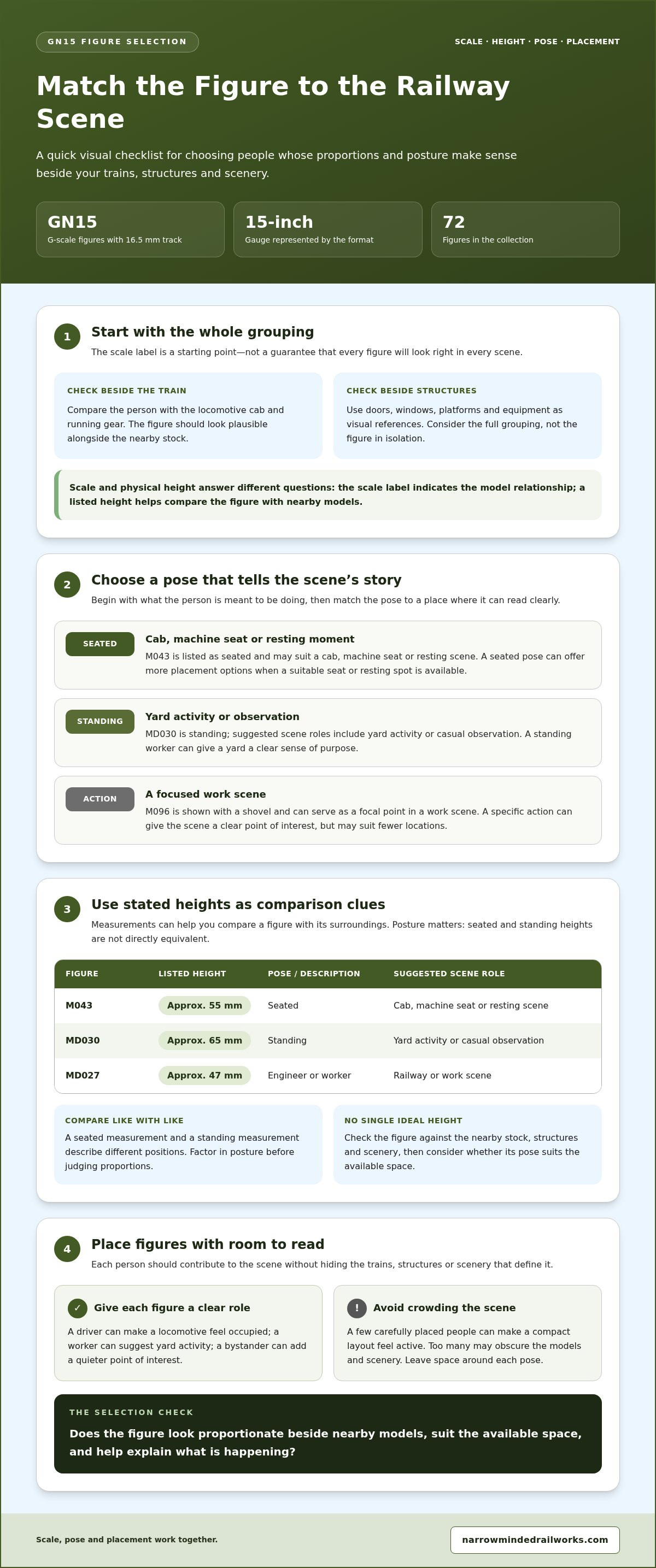
To compare gn15 figures effectively, look at the whole grouping rather than treating a stated height as a pass-or-fail measurement. Place or visualise the figure beside the locomotive, structure or piece of machinery it will accompany. A height that seems large on its own may look appropriate beside a tall cab, while a shorter figure may suit a low doorway or seated position.
Scale describes how a model relates to its real-world subject, while a measurement in millimetres tells you the figure’s physical height. The National Model Railroad Association’s guide to model railroad scales explains the scale concept. For practical selection, combine that label with the stated figure height and intended pose or use.
A figure’s pose changes both its apparent height and its purpose, so compare its position with the scene it will occupy.
Choose a Pose That Fits the Job
Start with the activity you want the scene to suggest. Seated figures such as M043 or MD087 can suit a locomotive cab, a machine seat or a resting moment. Standing figures such as MD030 or DR009 can establish yard activity or show someone observing the railway. M096, shown with a shovel, can serve as a focal point in a work scene. A specific action gives a scene a clear point of interest, while a seated pose may offer more options if there’s a suitable seat or resting spot.
Use Listed Heights as a Comparison Aid
Measurements are useful, but compare like with like: seated and standing heights describe figures in different positions and shouldn’t be treated as equivalent. Consider the figure’s posture and surroundings before deciding whether the proportions feel right.
| Figure code | Stated height | Pose or description | Suggested scene role |
|---|---|---|---|
| M043 | Approx. 55 mm | Seated | Cab, machine seat or resting scene |
| MD030 | Approx. 65 mm | Standing | Yard activity or casual observation |
| MD027 | Approx. 47 mm | Engineer or worker | Railway or work scene |
There’s no universal ideal height for every GN15 layout. Compare the listed measurement with nearby stock, structures and scenery, then check that the figure’s pose suits the available space. To explore options by figure and scene role, browse the GN15 figure collection.
Which GN15 Figure Should You Choose for Your Scene?
Choose a figure based on what your scene needs to communicate. A seated driver can make a locomotive feel occupied, a worker can give a yard a clear purpose, and a distinctive cameo can draw attention to a quieter corner. One well-placed figure can anchor the scene; a second or third can suggest activity without making the layout feel crowded.
For visual inspiration, you might look at how model railway scenes are presented in established hobby publications such as Model Railroader magazine. On your own layout, focus on a simpler question: what should a viewer notice first, and which pose helps tell that story?
Figures for Locomotive Crews and Yard Work
For a locomotive scene, M032 is described as suitable for a driver or someone resting. Its seated pose can give the cab a clear function. If the scene centres on work, MD027 is described for an engineer or worker shovelling coal, making it a natural option for a work-focused setting. MD013 offers a standing or working-around-the-yard example, which can extend the activity beyond the locomotive.
Consider how the figures relate to one another. A crew figure can be the focal point beside or in the locomotive, while a nearby worker suggests that the yard is in use. Leave enough open space to keep each pose readable, especially on a compact layout.
Figures for Everyday Cameos and Scenic Details
Not every person needs to be part of railway operations. MD260, a metal detectorist, provides a distinctive search-themed cameo. M095 is described as painting on a ladder, making it suited to a scene beside a building or fence. For a more active repair moment, M094 is shown with a sledgehammer. These described uses give each figure a clear purpose without requiring an invented backstory.
| Scene type | Pose or activity | Example figure |
|---|---|---|
| Locomotive crew | Seated driver or resting person | M032 |
| Coal or yard work | Engineer or worker shovelling coal | MD027 |
| Everyday yard activity | Standing or working around the yard | MD013 |
| Scenic cameo | Metal detectorist | MD260 |
| Building or fence detail | Painting on a ladder | M095 |
| Repair scene | Action pose with a sledgehammer | M094 |
Start with one figure that makes the scene’s purpose clear, then add supporting people only if they contribute a separate activity or point of interest. This helps gn15 figures feel connected to the layout rather than simply placed on it.
What to Compare Before Buying GN15 Figures
A figure can look appealing on its own yet feel awkward beside a locomotive, building or piece of equipment. Before choosing, compare the listing’s scale suitability, described pose and approximate height with the space where you plan to position it. This quick check helps you select for the scene, not just on appearance.
There’s a trade-off between a specific action pose and a more flexible seated figure. An action figure can give a work scene an immediate focal point, but its posture may suit fewer locations. A seated figure can work in a cab or resting scene, provided there’s a suitable seat or surface. If you plan to paint a figure, consider its material and follow suitable preparation and finishing guidance.
Common Figure-Buying Mistakes to Avoid
- Assuming every height is measured standing: A seated figure’s listed height reflects a different position, so don’t compare it directly with a standing person as if the measurements were equivalent.
- Repeating the same pose: Several identical figures can make a scene feel static if it’s meant to show different activities. Vary the roles or postures where the setting calls for it.
- Choosing a spot before checking the pose: An extended or working posture may need more room than a seated one. Consider the figure’s footprint and orientation alongside the available space.
A Simple Checklist Before Adding to Your Layout
Use this checklist when comparing gn15 figures. It keeps the decision focused on fit and function:
- Confirm the listing describes the figure as suitable for GN15 or G-scale modelling.
- Read the stated pose and intended use, rather than relying on the image alone.
- Compare any documented approximate height with nearby stock, structures and scenery.
- Decide whether the figure will be a crew member, worker, bystander or focal point.
- Check that the pose suits the exact space where you intend to place it.
There’s no single “correct” choice, since the best fit depends on your layout and the effect you want. These checks can help narrow the options before you add a figure to your scene. Browse GN15 figures by pose and scene role to compare options.
Browse GN15 Figures and Build a More Convincing Scene
A strong figure choice starts with the moment you want your layout to show. Rather than browsing by appearance alone, work from scene purpose to pose, then check dimensions and placement. This makes it easier to select people who contribute to the railway’s story and sit naturally beside its stock, buildings and scenery.
A Four-Step Figure Selection Process
- Identify the scene. Decide whether you’re showing a locomotive at work, activity in a yard, a person near a building or a quieter scenic moment. A clear idea helps you avoid choosing figures without a defined role.
- Choose a pose. Consider whether a seated, standing or action pose best communicates that moment. A seated person can suggest a cab or resting place, while a standing or action pose can make work or observation easier to read.
- Compare dimensions. Use any stated approximate height as a practical comparison point. Remember that a seated figure’s measurement isn’t directly equivalent to a standing figure’s, and judge both alongside nearby models.
- Picture the placement. Check that the pose fits the available space and faces into the scene naturally. Allow room for the figure to remain visible without obscuring important layout details.
If you want broader context before making a selection, revisit the article’s GN15 scale introduction. Then use the same scene-first approach to compare the listings and their stated uses.
Turn One Figure Choice into a Complete Scene
Begin with a focal figure: the driver, worker or cameo that makes the scene’s purpose clear. Add supporting people only where they help explain another activity or make the setting feel occupied. A varied group of poses usually reads more naturally than a row of people standing in the same way.
The collection contains 72 products, with choices that include seated drivers, standing workers and action poses. That range gives you options for different GN15 scene roles, whether you’re detailing a locomotive, a yard or a small area beside a building. Let the layout’s story guide your selection, and use the listed pose, approximate dimensions and suggested use to make a considered choice.
Ready to put the guide into practice? Browse GN15 figures and choose the right additions for your layout.
Bring Your GN15 Scene to Life
The right people help a layout tell a clearer story. Choose gn15 figures by considering scale suitability, stated height, pose and the role each person will play. Compare figures with nearby models, then place a focal person first and add supporting figures only where they help the scene feel active without becoming crowded.
The collection includes 72 GN15 figure products made from 3D scans of real people. Selected listings provide approximate heights and suggested uses, giving you useful details to weigh as you plan a locomotive crew, working yard or scenic cameo. Let the moment you want to show guide your choice, and use the listing details to find a natural fit.
Browse the GN15 figure collection and explore options for your layout. A carefully chosen pose can turn a small detail into a scene with purpose, so enjoy shaping a railway that feels distinctly yours.
Frequently Asked Questions
What are GN15 figures?
GN15 figures are people used to add scale, activity and character to a GN15 model railway or diorama. Narrow Minded Railworks describes its figures as G-scale models also suitable for GN15. Choosing gn15 figures means considering more than the category label: compare the stated pose and approximate height with nearby locomotives, buildings and scenery. The intended scene matters too, since a driver, worker or bystander each suggests a different activity.
Can I use G-scale figures on a GN15 layout?
Yes, the collection describes its G-scale figures as also suitable for GN15. To decide whether a particular figure fits your scene, read its product description and compare its pose and stated height with nearby models. A seated figure and a standing figure can create different proportions, so picture each one in its intended position. Check the available space as well, especially if the pose suggests a specific activity.
How tall are GN15 figures?
There isn’t one standard height across the collection; approximate dimensions vary by figure. For example, M043 is described as approximately 55 mm tall, while MD030 is approximately 65 mm. Check the individual product description and note whether the figure is seated or standing, since posture affects how its measurement looks on the layout. Compare the figure beside nearby stock, structures and scenery rather than relying on the number alone.
Which GN15 figures are suitable for a locomotive driver?
Start with a seated figure if you’re populating a cab or creating a scene around a machine. M032 is described as suitable for a driver or someone resting, while MD087 is described as suitable as a seated driver or machine operator. Compare the figure’s pose and approximate dimensions with the space available before choosing a position. A suitable fit should look natural beside the cab and leave the scene’s details visible.
Are GN15 figures supplied painted?
Some figure descriptions identify the models as unpainted, but the wording can differ between listings. Read the product description for the specific figure you’re considering so you can plan its finish accordingly. If you intend to paint a figure, consider the material and follow suitable preparation and finishing guidance for the model.
How do I choose between seated and standing GN15 figures?
Choose the pose that suits both the scene and the space available. Seated figures can suggest a driver in a cab, an operator at a machine or someone resting. Standing figures may work for yard activity, casual observation or a scenic cameo. Compare each figure’s stated pose and approximate height with nearby models, then vary postures if you’re building a group so the scene doesn’t look repetitive.
Which GN15 figure works best for a railway yard scene?
Match the figure to the activity you want the yard to show. MD027 is described as an engineer or worker shovelling coal, while M096 carries a shovel and M094 is shown with a sledgehammer. For a less specific yard scene, consider a driver or standing figure. Read the product descriptions to compare each documented pose and intended use, then choose one that fits the scene’s available space and purpose.
How can I make GN15 figures look natural on a layout?
Begin with one figure that makes the scene’s main activity clear. Position it in relation to the locomotive, building or equipment it interacts with, then add supporting figures only where they help explain what’s happening. Vary poses and avoid placing people in a line without a clear reason. Before positioning them, compare their approximate dimensions with surrounding models to help maintain a convincing sense of scale.