

Could the locomotive body that looks right on screen still be the wrong kit for your layout? With 3D printed narrow gauge kits, appearance is only part of the decision. Scale, track gauge and chassis compatibility matter just as much.
It’s easy to confuse scale with gauge, especially when a model uses a larger scale on narrower track. OO9, for example, represents models in 4mm scale running on 9mm track. Understanding the difference helps you choose a kit that suits both your modelling plans and your railway.
This guide explains how to compare scales, check whether a locomotive body is designed for a suitable chassis, and plan for assembly and finishing. You’ll also learn what to look for in a product listing, including which components are supplied.
Kit contents and compatibility vary, so don’t assume every model includes a chassis, motor or the same set of parts. Narrow Minded Railworks offers kits across OO9, GN15 and O-16.5 / 7mm scales, but doesn’t sell chassis or motors. Check the details for each kit before ordering so you know what else your build may require.
Key Takeaways
- Choose 3D printed narrow gauge kits based on the model and layout you want to build, not the print method alone.
- Check each listing for scale, intended use and the specific parts supplied.
- Allow for possible preparation, assembly and finishing, as build requirements vary by kit.
- Confirm documented chassis compatibility before buying a locomotive kit, and source a suitable chassis separately if required.
- Compare the OO9, GN15 and O-16.5 / 7mm kit categories to find an option that fits your project.
What Makes a 3D Printed Narrow Gauge Kit Different?
A 3D printed narrow gauge kit is a model-building product for a narrow-gauge railway subject. It isn’t necessarily a complete model ready to place on the track. Depending on the listing, you may receive parts for a locomotive, wagon or scenery, with additional components or modelling work needed to finish the project.
Before choosing a kit, separate three ideas: scale is the model’s size in relation to its real-world subject, gauge is the distance between the rails, and kit format describes what you need to build or supply. Knowing the difference makes it easier to compare options without assuming that kits for different modelling contexts are interchangeable.
For a visual example of a narrow-gauge model build, watch this video:
How scale and track gauge relate in narrow gauge modelling
Narrow gauge refers to a railway whose rails are closer together than those of standard gauge. The narrow-gauge railway entry provides broader historical and technical context. In modelling, scale and track gauge work together to represent these railways, but they describe different measurements.
OO9 is one example: it uses 4mm scale models on 9mm track. GN15 and O-16.5 / 7mm are distinct modelling contexts, not alternative names for OO9. Check the stated scale and track gauge against your layout before ordering. For more background, see this narrow gauge railway introduction.
What “kit” means before you start building
A kit may require you to source additional components, assemble parts, and prepare or finish the model. Requirements vary, so read the product listing for its contents and any documented compatibility information. Some kits are designed to fit commercially available chassis, but that doesn’t mean every chassis will fit every body.
Narrow Minded Railworks sells kits for modellers who want to build their models. It doesn’t sell ready-to-run models, chassis or motors. Confirm the kit’s contents and any chassis requirements before you begin, so you can plan around the parts you’ll actually need.
How 3D Printing Shapes a Narrow Gauge Kit Build
3D printing produces model components from a digital design and can be used to make parts for specialist railway subjects. The process alone doesn’t tell you what a kit contains, how it will assemble or what finish it needs. Those details depend on the individual design and product listing.
For general context, the American Society of Mechanical Engineers outlines several innovative ways to use 3D printing. For modellers, the practical point is to treat each set of printed components as its own project. Don’t assume a particular material, surface quality, strength or level of detail from the words “3D printed” alone.
What to check about components and kit contents
Compare the product description with its photographs before ordering. Look for an explicit list of supplied parts, and distinguish confirmed inclusions from components shown only in a finished-model image. If the listing doesn’t make this clear, ask the seller before buying.
For a locomotive kit, check whether a chassis or motor is included or needs to be sourced separately. Narrow Minded Railworks doesn’t sell chassis or motors, and compatibility shouldn’t be assumed. Some kits are designed for commercially available chassis, but the relevant listing should identify any documented fit.
Use this quick check:
- Which components does the listing explicitly say are included?
- Are any running parts or other items required but not supplied?
- Does the listing state chassis compatibility or identify parts you must obtain separately?
Preparing for assembly and finishing
Preparation isn’t identical for every kit. Some printed components may need attention before assembly or painting, but the steps depend on the product. Read the instructions and product-specific notes first, then choose tools and materials to match them. Don’t apply a routine from another kit unless its guidance is relevant.
Finishing is part of the modelling work, but requirements vary. Check whether the instructions explain any preparation, assembly or painting steps, and plan accordingly. For broader advice on paint and finish, see this guide to painting 3D printed models.
These checks help set realistic expectations before you commit to a build. If you’re comparing kit options, you can also explore Narrow Minded Railworks’ model kits and review each listing for its stated contents and compatibility.
Compare Scales, Chassis Fit and Kit Types Before Choosing
Start with your layout rather than a general ranking of scales. Consider the space available, the subjects you want to model and any track you already own. The kit’s scale and intended track context need to suit those plans. The additive manufacturing process explains how components can be produced, but it doesn’t determine which scale or chassis will suit your railway.
Use the table to compare the confirmed kit categories, then check the relevant product listing for details. The categories shown don’t mean every type of kit is available in every scale.
| Modelling context | Confirmed kit categories | What to verify before choosing |
|---|---|---|
| OO9 | Locomotive and wagon kits | Track suitability, supplied parts and any documented chassis compatibility. |
| GN15 | Locomotive and scenery kits | The intended layout context, kit contents and any separate components required. |
| O-16.5 / 7mm scale | O-16.5 / 7mm scale kits | The specific subject, track requirements and what the listing says is included. |
Which narrow gauge scale suits your layout?
There isn’t one right choice for every modeller. Existing track may make one context easier to adopt, while available space, railway subject and the kind of scene you want to create may point towards another. Confirm the scale and track requirements rather than relying on a label alone. For more focused guidance on selecting OO9 locomotive kits, read the OO9 beginner’s guide.
How to verify locomotive body and chassis compatibility
A locomotive body that looks close to the right size isn’t proof of a fit. Check the listing for the exact chassis make and model, along with any stated dimensions or fitting notes. Don’t assume compatibility based on scale, appearance or another kit’s description. Some Narrow Minded Railworks kits are designed for commercially available chassis, but compatibility must be confirmed for each kit.
Chassis and motors are sourced separately. Narrow Minded Railworks doesn’t sell them. Before ordering, confirm whether the listing names a suitable chassis and whether you can obtain it. If the information isn’t clear, ask the seller rather than risk a mismatch.
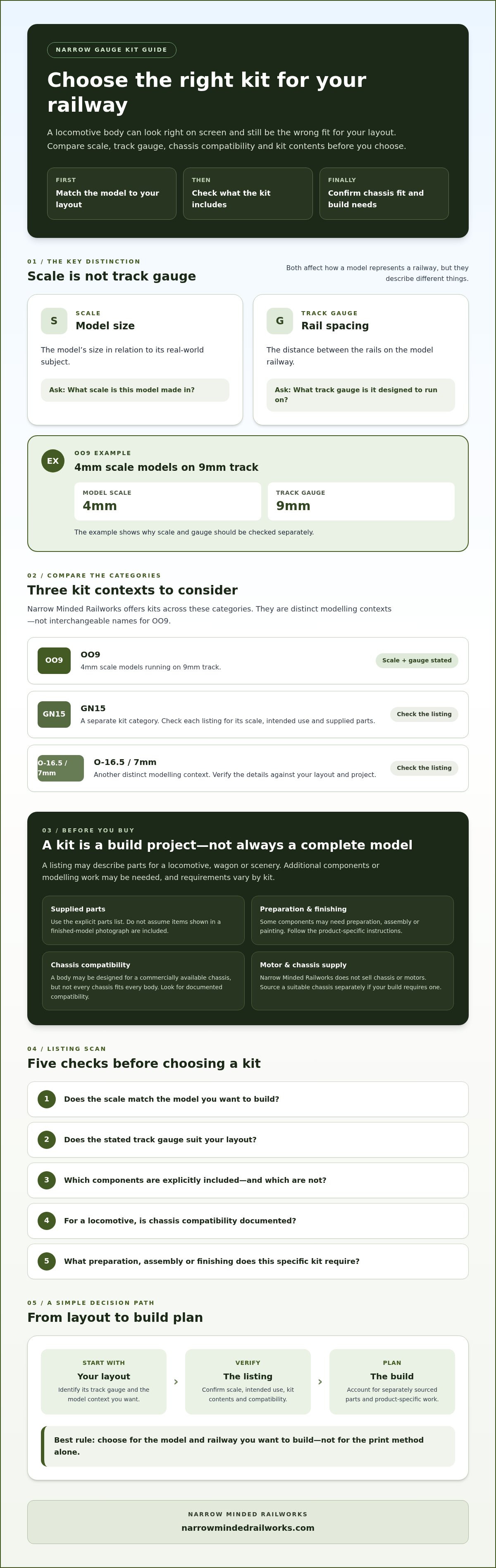
A Practical Checklist for Buying 3D Printed Narrow Gauge Kits
A careful listing check can prevent a mismatch between your layout, the kit and the parts needed to complete it. Use this checklist before placing an order. If a detail isn’t stated, ask the seller instead of relying on a photograph or assuming another kit follows the same pattern.
- Match the scale and intended use. Check the stated scale and confirm it suits your layout, track and modelling plan. Make sure the kit is intended for the subject you want to build, such as a locomotive, wagon or scenery.
- Read the contents carefully. Identify what the listing explicitly says is included. Don’t treat parts shown in a finished-model photograph as supplied unless the description confirms them.
- Check required components. For a locomotive, look for a clear statement about whether a chassis or motor is included or needs to be sourced separately. Narrow Minded Railworks doesn’t sell chassis or motors, so plan for any separately required components.
- Verify compatibility. Look for the exact chassis make and model, dimensions or fitting notes named in the listing. Scale or visual similarity alone doesn’t establish a fit. If the listing lacks enough information, contact the seller before ordering.
- Assess the build scope. Check any instructions or product notes for assembly and finishing requirements. Consider whether the work suits your experience and whether you have the tools and materials the listing calls for.
Questions to answer before placing an order
Can you identify the track and scale the kit is intended for? Do you know which components are supplied and which you’ll need to obtain? If it’s a locomotive body, has the listing documented compatibility with a specific chassis? Resolve these points first. A short enquiry can clarify uncertainty and help you avoid buying a kit that doesn’t match your project.
Match the kit to your experience and project
Kit-building can involve more than assembly, and the work varies by product. If the listing doesn’t explain the build scope, ask what preparation or finishing is expected before deciding. GN15 modellers can explore the GN15 scale guide for more context when planning a project in that scale.
Narrow Minded Railworks ships worldwide, though the listing and seller should be consulted for order-specific information. Once you’ve checked scale, contents and compatibility, browse the narrow gauge kit range to compare options for your build.
Explore Narrow Minded Railworks’ 3D Printed Narrow Gauge Kits
Narrow Minded Railworks offers kits across several narrow gauge modelling contexts. The range is for people who want to build and finish models themselves, rather than buyers looking for ready-to-run models. Choosing a category is a useful first step, but check the scale and requirements of each individual kit.
Find a kit category that matches your modelling project
Use the categories below to narrow your search by project type. They describe the confirmed range, not a guarantee that every type of model is available in every scale.
- OO9: locomotive and wagon kits. Consider this category if you want to add these models to an OO9 layout, then confirm each kit’s stated scale, contents and any chassis information.
- GN15: locomotive and scenery kits. Review the listing to see which subject it covers and what you’ll need for your planned build or scene.
- O-16.5 / 7mm scale: kits in this modelling context. Check the listing for the specific subject, included components and intended use rather than assuming it matches another scale category.
Narrow Minded Railworks also offers diorama tools and scenery. These are separate from locomotive and wagon kits, so check the relevant listing to confirm what each item is for and what it includes.
Take the next step with clear expectations
Before choosing, compare the product listing with your layout and build plan. Confirm the stated scale, inspect the included-parts information and look for documented compatibility if a locomotive kit needs a separate chassis. Don’t infer a fit from appearance or assume details for one kit apply to another.
The business sells kits and accessories, not ready-to-run models, chassis or motors. Some kits are designed to fit commercially available chassis, but the product listing is the place to verify any stated compatibility. If a description or photograph leaves an important detail unclear, ask the seller to clarify it before ordering.
With those checks in mind, compare the range according to your project rather than choosing on appearance alone. Browse Narrow Minded Railworks to explore the kit categories and review the details for each listing.
Choose Your Next Narrow Gauge Build
The right 3D printed narrow gauge kits start with a clear match between your layout, intended scale and modelling plans. Check each listing for included parts and build requirements, then verify any stated chassis compatibility rather than assuming a body will fit. These checks help you plan the project with realistic expectations.
Narrow Minded Railworks offers kits across OO9, GN15 and O-16.5 / 7mm scale modelling. Some are designed to fit commercially available chassis, which are sourced separately. The business ships worldwide, so readers beyond the UK can explore the range and check listing details for their project.
Ready to compare the options? Browse the 3D printed narrow gauge kit range and check the individual product information before ordering. A well-matched kit can be a rewarding starting point for your next model railway build.
Frequently Asked Questions
What are 3D printed narrow gauge kits?
3D printed narrow gauge kits are model-building products for subjects associated with narrow gauge railways. They may contain components for a locomotive, wagon or scenery, but the exact contents depend on the individual kit. “Narrow gauge” describes the railway context, while scale describes the model’s size relative to its real subject. Check the product listing to understand what parts are supplied and what you’ll need to complete the build.
Are 3D printed model railway kits ready to run?
No, don’t assume a kit is ready to run. It may need assembly, preparation and finishing, and some locomotive kits may require a separately sourced chassis or motor. Requirements vary, so check the instructions and product listing for each model. Narrow Minded Railworks sells kits for modellers to build, not ready-to-run models, so review the stated contents before ordering.
How do I choose a scale for a narrow gauge kit?
Choose a scale that suits your layout space, intended railway subject and existing track. Scale is the model’s size relative to the real subject; track gauge is the distance between the rails. For example, OO9 uses 4mm scale models on 9mm track. GN15 and O-16.5 / 7mm represent different modelling contexts, so check each kit’s stated scale and track requirements rather than treating them as interchangeable.
Will a 3D printed locomotive body fit my chassis?
It will fit only if the body is designed for that chassis or can be adapted appropriately. Check the product listing for a named chassis model, dimensions and fitting notes. Don’t infer compatibility from appearance or scale alone, and don’t assume one kit’s information applies to another. If the listing doesn’t confirm a fit, ask the seller before buying or sourcing a chassis.
Do narrow gauge kits include a chassis and motor?
Contents vary by kit, so check the listing rather than assuming a chassis or motor is included. Narrow Minded Railworks doesn’t sell chassis or motors. Some kits are designed to fit commercially available chassis, but that doesn’t mean every body fits every mechanism. Confirm the specific kit’s stated compatibility and identify any additional components you’ll need before starting your build.
Are 3D printed kits suitable for beginner modellers?
They can suit beginners who are prepared to build and finish a model, but the work involved varies by kit. Read the product notes and any available instructions to understand the assembly and preparation required. Consider whether you have the tools and confidence for those steps. If the build scope isn’t clear, ask the seller before choosing a project that fits your experience.
What should I check before buying a 3D printed narrow gauge kit?
Confirm the scale and intended use first, then check the listed contents and any required parts. For a locomotive body, look for documented chassis compatibility, including the make and model where stated. Review instructions or product notes for assembly and finishing expectations. Product photographs may show a completed model, so don’t assume every visible component is supplied. Ask the seller to clarify any important detail that remains uncertain.