

Have you ever stared at your layout, puzzled as to why a new locomotive looks out of place next to your buildings, even though it runs perfectly on the track? Or perhaps you've hesitated before spending over £100 on a kit, worried that the cryptic 'OO9' or 'HOn30' will be an expensive mistake? This confusion between an item's size and the track it runs on is a common hurdle for hobbyists across the UK, but the key is understanding model railway scales.
This ultimate 2026 guide is here to clear the fog. We’ll break down the crucial difference between scale and gauge, demystify the numbers like 1:76 and 1:87, and give you a clear map of all the popular choices. You'll leave with the confidence to expand your collection, mix and match components correctly, and even take your first exciting step into the intricate world of narrow gauge modelling without fear.
Key Takeaways
- Learn the critical difference between scale (the model's size ratio) and gauge (the track width) to avoid common purchasing mistakes.
- Use our simple framework to choose the perfect scale for your layout by evaluating your available space and preferred modelling era.
- Go beyond the basics by comparing the 'Big Five' from Z to O, a key step in understanding model railway scales and what will work best for you.
- Demystify the world of narrow gauge modelling and learn how to use standard track to create unique and characterful layouts.
Scale vs. Gauge: The Fundamental Difference Every Modeller Must Know
When you first step into the world of model railways, two terms appear everywhere: scale and gauge. While often used interchangeably by beginners, they mean two very different things. Getting this right is the first and most crucial step in understanding model railway scales and building a collection that works together seamlessly.
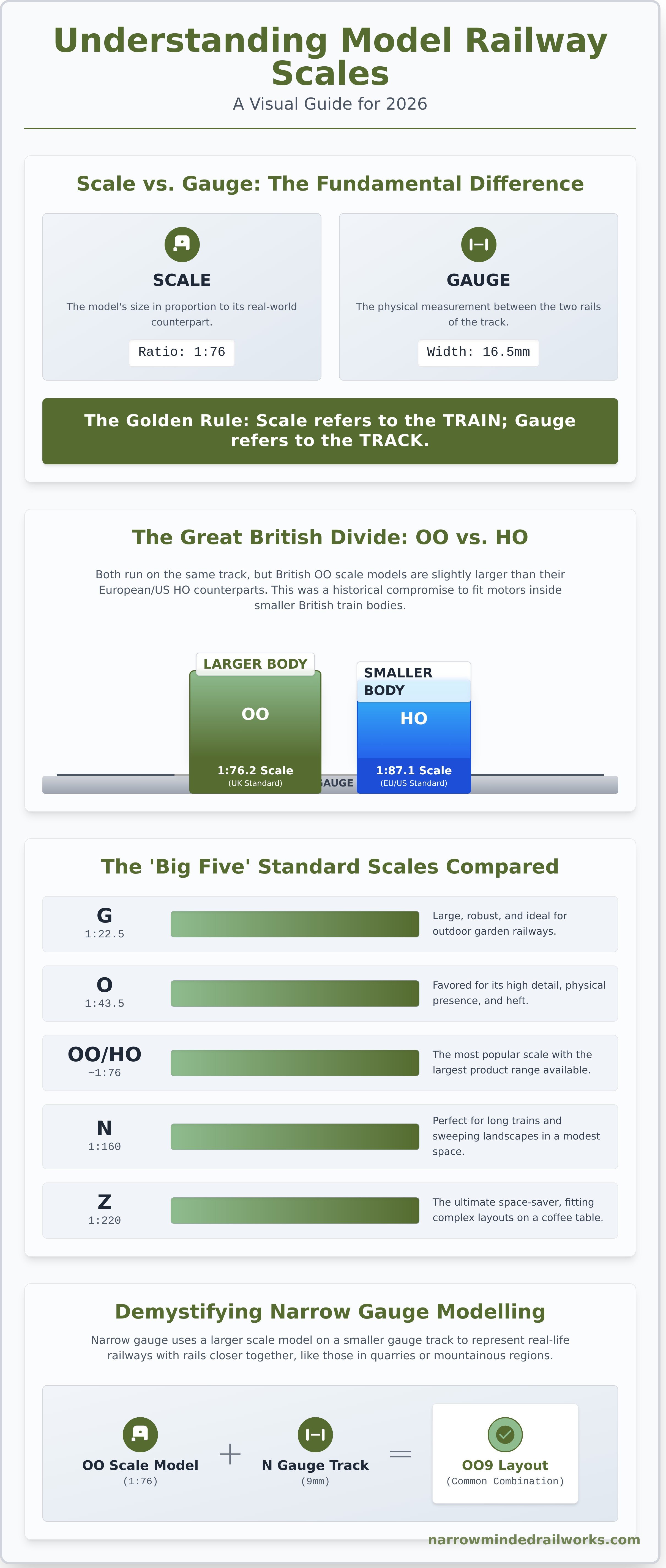
The golden rule is simple: Scale refers to the train; Gauge refers to the track. Scale is the ratio of the model's size compared to its real-world counterpart. Gauge, on the other hand, is the specific measurement between the two rails of the track. The confusion arises because different scales can, and often do, run on the same track gauge.
This video clearly illustrates the key differences between the popular OO and HO scales, which is a perfect example of this concept in action:
Understanding the Ratios (1:48, 1:76, 1:87)
Scale is expressed as a ratio, like 1:76. This simply means that every one unit of measurement on the model (e.g., 1mm) represents 76 units on the real-life prototype. In the UK, the most popular scale is OO, which is 1:76.2. Most of Europe and North America, however, use the slightly smaller HO scale, which is 1:87. Historically, this divergence occurred because early British models needed larger bodies (1:76) to house the bulky motors of the time, but they were built to run on the more widely available 1:87 scale track.
Why Gauge Matters for Realism
In the real world, not all railways use the same track width. The most common is 'Standard Gauge' (4 feet 8½ inches), but many industrial, rural, and mountain lines used 'Narrow Gauge' track. This is where the distinction becomes vital for realistic modelling. For instance, a UK modeller might use OO scale (1:76) locomotives but run them on 9mm wide track (known as OO9) to accurately represent a narrow-gauge railway. The world of model railroading has dozens of scale and gauge combinations, as detailed in the comprehensive list of Model Railway Scales on Wikipedia, allowing you to model almost any prototype imaginable.
The 'Big Five' Standard Scales: A Comparison for 2026
While hundreds of niche scales exist, the vast majority of the model railway world revolves around five key players. Choosing the right one is the most critical step in understanding model railway scales and ensuring long-term enjoyment of the hobby. Each offers a unique balance of detail, space requirements, and operational potential. Let's break down the most popular choices for UK modellers in 2026.
- Z Scale (1:220): The smallest commercially available scale. Z scale is the ultimate space-saver, allowing for complex layouts on a coffee table or even inside a briefcase. Its tiny size makes it a marvel of engineering, but it can be challenging to work with for those with less-than-perfect eyesight or dexterity.
- N Scale (1:160): Often considered the perfect compromise. N scale allows you to model impressive, long passenger trains and sweeping landscapes in a modest space like a spare bedroom. The detail on modern ready-to-run models from brands like Dapol and Graham Farish is simply outstanding.
- HO/OO Scale (1:87 / 1:76): The undisputed kings of the hobby. In the UK, OO scale (1:76) is the standard, while HO (1:87) dominates in Europe and North America. The sheer volume of locomotives, rolling stock, and scenic accessories available from giants like Hornby and Bachmann makes this the most accessible entry point.
- O Scale (1:43.5 in UK): For modellers who crave detail and physical presence. O scale models have a satisfying weight and heft, allowing for super-detailed engines with features like working smoke and advanced digital sound. While it requires significant space, its impact is undeniable.
- G Scale (1:22.5): Take the hobby outside! G Scale is large, robust, and designed to withstand the elements, making it the premier choice for garden railways. These large-scale models create a magical experience as they navigate flowerbeds and garden paths.
HO vs. OO: The Great British Divide
You'll notice two scales listed for the most popular size. Historically, early British manufacturers found it impossible to fit the motors of the day inside the smaller frames of UK locomotive prototypes at the correct 1:87 (HO) scale. Their solution was to increase the body size to 1:76 (OO scale) but cleverly keep it running on the widely available 16.5mm HO gauge track. This compromise remains the UK standard today, offering an unparalleled product range at the cost of a slightly inaccurate track gauge.
Small Scale Advantages: N and Z
The primary benefit of N and Z scales is the ability to model a grand vision in a small footprint. Where an OO scale layout might manage a small branch line terminus in a spare room, an N scale modeller can build a bustling mainline junction in the same space. The trade-off is in complexity; while scenery can be more expansive, working on the tiny motors and mechanisms requires more patience. For 2026, the ready-to-run market is incredibly strong, offering superb detail straight from the box, though kits are still available for dedicated builders.
The Narrow Gauge Maze: Understanding OO9, On30, and GN15
Venturing beyond the mainline opens up the charming and characterful world of narrow gauge modelling. These are railways where the track gauge is narrower than the standard 4ft 8½in, often used for industrial, agricultural, or quarry lines where tight curves and steep gradients were common. The appeal lies in modelling these quirky, hard-working prototypes that tell a unique story.
The secret to narrow gauge's accessibility is a clever 'cheat code': using the track and mechanisms from smaller, standard gauge scales. This allows you to run larger-scale models on commonly available track, creating the narrow gauge illusion perfectly. Getting to grips with this concept is a vital step in understanding model railway scales and their creative potential.
OO9: The Most Popular Narrow Gauge Choice
For many in the UK, OO9 is the gateway to narrow gauge. It combines 4mm:1ft scale models (the same as OO gauge) with 9mm wide track (the same as N gauge). This represents prototypes that ran on 2ft gauge tracks, like the famous Ffestiniog or Talyllyn Railways in Wales. Its popularity stems from a huge range of ready-to-run models, kits, and accessories from brands like Peco and Bachmann. The ability to use reliable N gauge chassis for kit-bashing also makes it a firm favourite for creating unique industrial locomotives.
On30 and O-16.5 Explained
If you prefer a larger, more detailed modelling experience, these scales are for you. They both cleverly use standard 16.5mm track (the same as OO and HO gauge) but with much larger 7mm scale models.
- On30: An American scale (1:48) representing 30-inch gauge track, popular for modelling logging and mining railroads.
- O-16.5: The British equivalent (1:43.5 or 7mm:1ft), perfect for modelling the many varied 2ft to 2ft 6in gauge lines that served UK industry.
The larger size makes them ideal for scratch-builders and those who love super-detailing locomotives and rolling stock, creating a truly immersive narrow gauge masterpiece on readily available track.
Finally, for those seeking something truly different, GN15 offers a whimsical experience, running large G-scale (1:22.5) models on 16.5mm track to represent tiny 15-inch gauge estate or industrial railways. It’s a niche that showcases the incredible diversity of the hobby.
Choosing Your Scale: A Framework for New Modellers
With the popular scales defined, the next step is personal. The perfect scale is a balance of your space, interests, and budget. For anyone new to the hobby, understanding model railway scales is less about technical ratios and more about practical application. Use this four-step framework to guide your decision.
- Step 1: Measure Your Space. Before anything else, measure the permanent, usable footprint you have. Is it a spare room, an 8ft x 4ft board, or just a single bookshelf? This is your primary constraint.
- Step 2: Define Your Era. Do you envision the golden age of steam, the blue-and-grey diesel era of the 1980s, or a quirky industrial line? Your chosen era affects the availability of models in certain scales.
- Step 3: Assess Your Skills. Be honest about your eyesight and dexterity. Larger scales like O gauge are more forgiving for assembly and detailing, while N gauge requires a steady hand.
- Step 4: Determine Your Budget. Decide how you want to allocate funds. Do you prefer a few highly detailed, expensive locomotives, or a vast scenic empire built on a tighter budget?
Space vs. Vision: What Do You Want to See?
A key part of understanding model railway scales is deciding on your scenic priorities. Do you want a train in a landscape, where long trains snake through impressive scenery (ideal for N gauge)? Or a landscape in a train, where the focus is on the intricate detail of the locomotives and rolling stock (common in O gauge)? For apartment dwellers or those with limited room, a ‘shelf layout’ offers a fantastic solution. These narrow, linear layouts fit neatly against a wall. This is where specialist narrow gauge kits truly shine, as they are designed for the tighter curves and smaller footprints that make shelf layouts so appealing.
The Cost of Entry
Your budget will significantly influence your choice. A new ready-to-run OO gauge locomotive from a major brand can easily cost between £150 and £250. In contrast, a detailed narrow gauge locomotive kit might cost £50 - £90. While the kit requires assembly, the process is incredibly rewarding and saves a considerable amount. Remember to factor in the hidden costs: track, a power controller (from £60 upwards), and essential tools can quickly add up, regardless of your chosen scale.
The Future of Scaling: 3D Printing and Custom Kits
For many years, venturing into the more specialist areas of the hobby meant facing an 'availability gap'. If you wanted to model a specific narrow gauge line or an obscure industrial prototype, you either had to scratch-build it or hunt for rare, often expensive, artisan kits. This is where the next step in understanding model railway scales truly begins: the revolution brought by 3D printing technology.
High-resolution 3D resin printing has democratised model making, allowing small, passionate businesses to create incredibly accurate and detailed models that were previously unviable. This has closed the availability gap, particularly for narrow gauge enthusiasts. It has also revitalised the culture of kit-building, moving the focus from simply buying 'Ready-to-Run' (RTR) to the immense satisfaction of creating something unique with a 'Built-by-Me' ethos.
Why 3D Printed Kits are the Best Entry Point
If the thought of kit-building sounds daunting, 3D printed kits are the perfect introduction. They deliver the crisp detail once reserved for complex brass kits but without the need for soldering irons or specialist tools. The process is straightforward and rewarding:
- High Detail, Low Complexity: Resin captures fine details like rivets and pipework perfectly, yet the bodies are typically one-piece, simplifying assembly.
- Proven Mechanics: Most kits are designed to fit directly onto a reliable, smooth-running commercial chassis from brands like Kato or Graham Farish. This removes the most difficult part of the build.
- Ultimate Customisation: You're in control. From the paint and livery to the level of weathering, you can create a locomotive that is truly one-of-a-kind and perfectly suited to your layout.
Getting Started with Narrow Minded Railworks
At Narrow Minded Railworks, we champion this modern approach to modelling. We focus on bringing unique prototypes to life in the most popular UK narrow gauge scales, including OO9, O-16.5, and the charmingly quirky GN15. To populate your worlds, we even 3D scan real people for our figure range, ensuring unparalleled realism. For anyone looking to progress their journey in understanding model railway scales, building a kit is a fantastic next step. Explore our growing collection of OO9 locomotive kits and scenic details to begin your own custom-building adventure.
Your Journey into Model Railways Starts Now
We've journeyed from the fundamental difference between scale and gauge to the exciting future shaped by 3D printing. The key takeaway is that understanding model railway scales is the crucial first step in building a layout that truly fits your space, vision, and passion. Whether you're drawn to the popular 'Big Five' or the intricate character of the narrow gauge world, making an informed choice empowers you to create a miniature world that is authentically yours.
If the unique charm of narrow gauge has captured your imagination, we can help you take the next step. As specialists in OO9 and GN15 scales, we are passionate about creating high-detail, 3D printed resin bodies that bring exceptional character to any layout. From our base in the UK, we are proud to offer worldwide shipping for our specialised kits.
Ready to build something extraordinary? Explore our unique range of Narrow Gauge kits and accessories and let your modelling adventure begin.
Frequently Asked Questions
What is the most popular model railway scale in the UK?
In the UK, the most popular model railway scale is overwhelmingly OO scale (1:76). This is largely because major manufacturers like Hornby and Bachmann focus on this scale. The vast availability of locomotives, rolling stock, and accessories makes it the easiest entry point for newcomers and a cornerstone for seasoned modellers. Fully understanding model railway scales often begins with OO for British enthusiasts, as it offers the widest support in local model shops.
Can I run OO9 trains on N gauge track?
Yes, you absolutely can. Both OO9 and N gauge use the same 9mm track gauge. The key difference is the scale of the models themselves; OO9 models are built to 4mm/ft scale (1:76) to represent narrow gauge prototypes, while N gauge is 2mm/ft scale (1:148). This popular combination allows you to create a detailed narrow gauge layout using the wide variety of commercially available N gauge track and mechanisms.
What does 1:76 scale mean in actual size?
The ratio 1:76 means that every one unit of measurement on the model is equivalent to 76 units on the real-life object. For instance, a real six-foot-tall person (72 inches) would be represented by a model figure that is just under one inch tall (approximately 24mm). A 40-foot real-world wagon would translate to a model around 158mm (about 6.2 inches) long. This ratio ensures all elements on your layout are proportionally correct.
Is HO scale the same as OO scale?
No, they are different scales, although they confusingly use the same track gauge. OO scale, the British favourite, is 1:76. HO scale, the most popular scale worldwide, is a slightly smaller 1:87.1. Both run on 16.5mm gauge track, but the size difference between the locomotives and rolling stock is noticeable when placed side-by-side. Most UK modellers choose to stick with one scale to maintain visual consistency on their layout.
What is the best scale for a very small space?
For a very small space, N gauge (1:148) is an excellent choice. It allows you to build a complete and interesting layout on a baseboard the size of a coffee table or even a shelf. If space is extremely limited, Z gauge (1:220) is even smaller, making it possible to create a fascinating scene inside something as compact as a briefcase. These smaller scales are perfect for flats or homes without a dedicated hobby room.
What is the difference between On30 and O-16.5?
Functionally, they are the same but represent different prototypes. Both use O scale models running on 16.5mm gauge track (the same as OO/HO). On30 is the American term for modelling 30-inch gauge railways in 1:48 scale. O-16.5 is the British equivalent, used for modelling 2-foot or 2-foot 6-inch gauge prototypes, such as Welsh slate quarry lines, in 1:43.5 scale. The difference lies in the real-world railway you are modelling.
Why is narrow gauge modelling becoming more popular?
Narrow gauge modelling offers immense creative freedom and is well-suited to smaller spaces. These railways often featured unique, characterful locomotives and wagons, appealing to modellers who want to build something different from a standard main line. Scales like OO9 allow for detailed scenery and tight curves in a compact area, making them perfect for intricate layouts. The growing availability of high-quality kits and 3D prints has made this fascinating niche more accessible than ever.
Do I need special tools to build 3D printed model kits?
You will need some basic modelling tools, but nothing overly specialised or expensive. Essential items include a sharp craft knife for removing supports, fine-grit files or sandpaper for a smooth finish, and superglue (cyanoacrylate) for assembly. A good pair of tweezers is invaluable for handling tiny parts. While an airbrush gives a professional paint finish, excellent results are achievable with fine brushes and quality acrylic paints, making it very approachable for beginners.